7www.zcorp-users.com
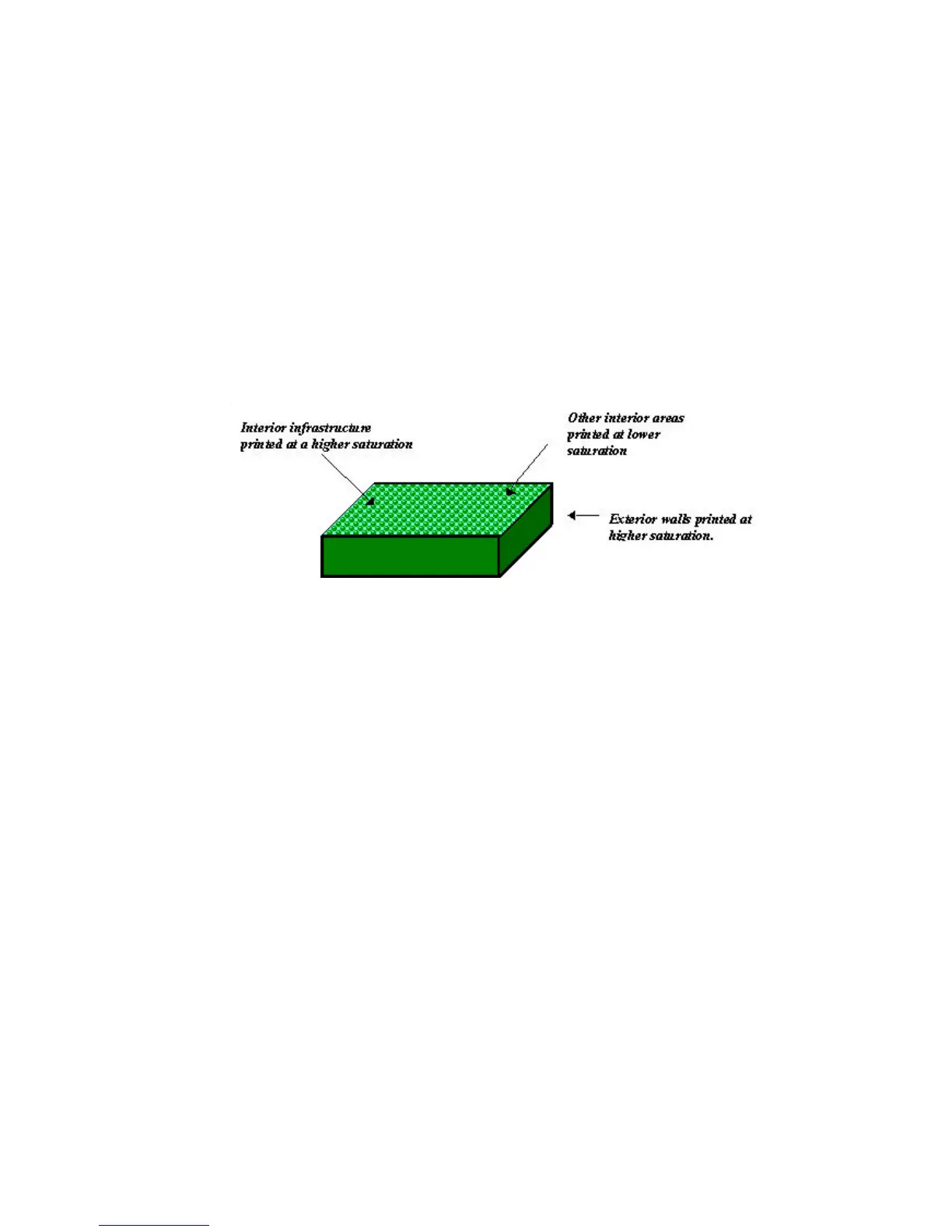
The ZPrinter 310 employs several techniques to quickly build great parts. First, binder solution is applied in a
higher concentration around the edges of the part, creating a strong “shell” around the exterior of the part. Within
parts, the printer builds an infrastructure by printing strong scaffolding within part walls with a higher concentration
of binder solution. The remaining interior areas are printed with a lower saturation, which gives them stability, but
prevents over saturation, which can lead to part distortion.
After printing, the part is removed from the powder bed, depowdered and dried. The part can then be infiltrated
with wax, or other performance resins to increase strength and durability. For more information regarding
infiltrants, see Chapter 6, Post-Processing.
Because the powder layers support the structures being printed above, the ZPrinter 310 prints parts without
support structures of any kind and can print parts with complex geometries that are impossible for other systems.
There are several important characteristics of the ZPrinter 310 that will help you print the best parts for your
intended purpose.
Part Placement. ZPrint Software will place the parts within the build box to maximize build speed, the most
important criteria for the majority of our users. ZPrint Software positions the parts with the smallest dimension
in the z (vertical) axis. In addition to part placement, however, the following other characteristics should be
considered.
Strength. The ultimate strength of the part will be affected by its orientation within the print box. The part will be
strongest along the y-axis and the x-axis and less strong along the z-axis. This is because the cross sections are
printed in continuous strips along the y-axis (the binder cartridge direction of travel), bands across the x-axis (the
gantry direction of travel) and laminated layers along the z-axis. This discussion only applies to untreated parts;
once parts are infiltrated, they uniformly take on the strength characteristics of the infiltrating material.


 To Next Page