4: Element Operations • 38
©2008 Axia Audio — Rev. 3.0
Sources are assigned to faders for use on-air or in
production. During initial configuration, the sources are
programmed by the engineer for appropriate logic and
options (as outlined in previous chapters); afterwards,
whenever that source is assigned to a fader, source logic
follows.
Fader settings are instantly reconfigured whenever a
source is selected, to accommodate the unique require-
ments of the source. For example, a fader controlling a
microphone source also controls appropriate monitor
mutes. A fader controlling a line source sends “start”
and “stop” commands when the channel is turned on
and off.
Sources can also be fed directly to the monitors for
auditioning without being assigned to a fader.
Mix-Minus
Mix-minus setup, especially for live broadcasts, has
always been one of the most confusing aspects of run-
ning a radio board.
Element makes mix-minus easy by automating it.
The operator never has to worry about sending a source
back to itself — it just can’t happen!
Several mix-minus choices – fixed and switching
– are possible, and are configured for each source when
Source Profiles are defined by the engineer (see Chap-
ter Two for details). Once this setup is done, no further
tweaking is needed; the operator simply uses the source.
A Status Symbol display on each fader tells operators
when a particular source has a mix minus output, and
even tells them which audio mix is being backfed.
Element will support as many outputs as there are
installed faders, each with its own automated mix minus
feed. Got 24 faders? You can have 24 mix-minuses!
GPIO
As explained in Chapter Three, each input source can
have associated GPIO (General Purpose Input/Output)
control associated with it. Element GPIO interfaces are
connected to Element via the Livewire network, so you
can locate the actual machine connections either physi-
cally close to source equipment or in a central equip-
ment room.
During installation, the engineer configures sourc-
es to accept and provide logic commands by selecting
various options. Example: studio microphones may be
set up to automatically mute the studio monitor speak-
ers and illuminate an on-air warning light when turned
on. The same sources can be configured to accept GPIO
logic inputs from buttons so each studio guest can have
their own On, Off, Talk, and Mute keys (see Chapter
One, “Setup and Configuration” for details ).
Line sources can be configured to receive start and
stop commands from the Element as well. Start/stop
messages can also be passed, via Ethernet, to a com-
puter-based playout system.
Monitor Module and SoftKnobs
The Monitor Module and SoftKnobs contain Ele-
ment’s operating controls. This is where you’ll find vol-
ume and selection controls for monitors and heaphones,
as well as keys that provide fast access to show profiles,
EQ & dynamics, Aux feeds and more. There are two dif-
ferent type of Monitor Modules: one that contains only
monitor and option controls, and one that subtracts some
monitor controls but adds two faders. We’ll outline how
each type works.
Software
The Element operating system uses a high-perfor-
mance embedded Linux kernel to help ensure bullet-
proof, 24/7 operation. Software updates can be obtained
from Axia via the Internet and applied by the station en-
gineer. Axia Support recommends performing backups
or making printouts of Show Profiles and other configu-
ration data before applying new software updates.
Control Callout
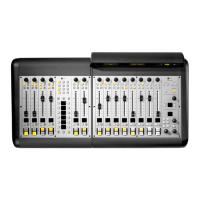
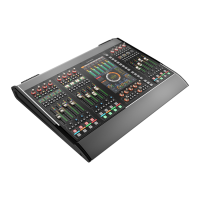
On the following pages are a “bird’s-eye view” of
Element, with major controls located and their functions
explained.


 To Next Page