,-
SECTION
4
CESSNA
NORMAL PROCEDURES
MODEL
2086 (675 SHP)
TAXIING
Power lever BETA range may be used during taxi to improve brake life.
A leaf spring is installed in the control quadrant which the power lever
contacts and provides the pilot with a noticeable "feel". With the power
lever moved to this position in the BETA range, the propeller is near
zero thrust in a static, 52% idle condition. Besides acting as a zero
thrust reference during taxi, this power lever position (lever against
spring) is used
after landing to minimize brake wear. Further an
movement of the power lever will result in increased engine power and
reverse thrust from the propeller blades.
CAUTION
THE USE OF REVERSE THRUST SHOULD BE
MINIMIZED, ESPECIALLY ON UNPREPARED
SURFACES, TO PROTECT THE PROPELLER.
TO MINIMIZE CARGO POD TEMPERATURES AND
AVOID DAMAGE TO THE POD SURFACES, DO NOT
LEAVE THE POWER LEVER IN THE BETA RANGE
FOR EXTENDED PERIODS (GREATER THAN 30
SECONDS) WHEN PARKED
WITH A RIGHT
NOTE
During low-speed taxi with a strong tailwind, or when
stopped with a strong tailwind, a moderate vibration may
occur as a result of reverse airflow through the propeller
disk with the blades at a positive pitch angle. This vibration
can be significantly reduced by placing the power lever in
the BETA range, or it can be eliminated by turning the
airplane into the wind.
1
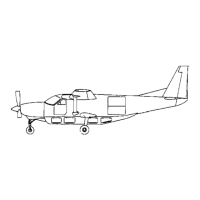
Refer to Figure
4-3
for additional taxiing instructions.
Revision
23



 To Next Page