2-2
Chadwick-Helmuth Company, Inc.
Chapter 2
- Overview and Basic Theory
2.2 Theory of Operation
This section gives an overview of the basic theory of the 8500C/C+’s operation.
2.2.1 Characteristics of Balancing
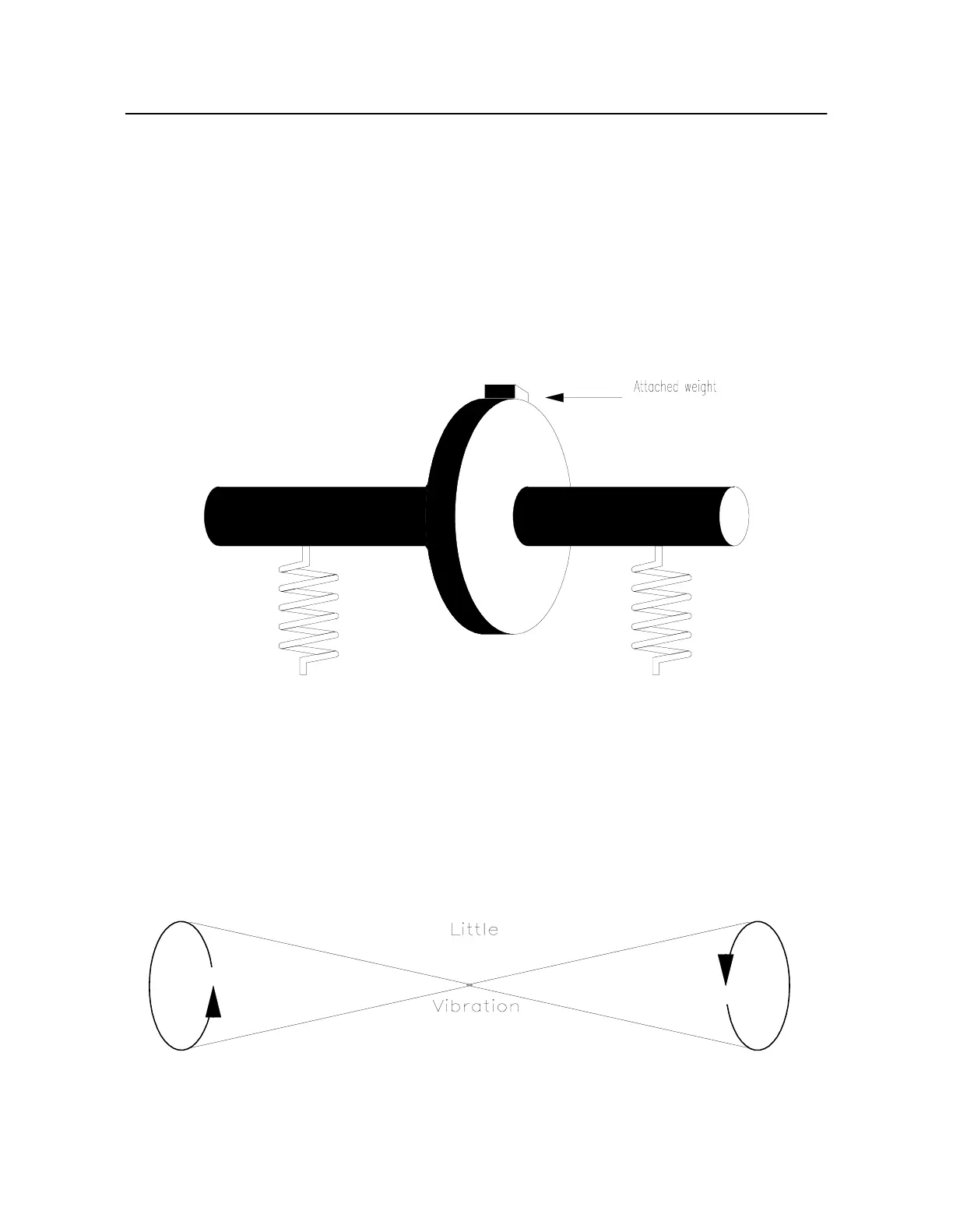
If a perfectly balanced circular disc is mounted on a rigid center spindle and rotated, the outward
centrifugal forces created are constant everywhere along the edge of the disc (see F igure2-1).
Consequently, the disc edge appears to maintain a perfectly stable circular orbit around the spindle axis
with no uneven or extraneous forces being transmitted to the surrounding environment.
Figure 2-1. Ideal Rotor With Weight And Supporting Springs
Now if a weight is added to the edge of the disc, the increased centrifugal force created there when th
disc is rotated perturbs its orbit, inducing a mass imbalance around the center of rotation and a wobble
along the spinning shaft (see F igure2-2). A supporting spring placed under the shaft at the point of
maximum wobble would accordingly feel the effects of this imbalance, experiencing an up-and-down
vibration once per revolution as the weighted disc edge passes through the top and bottom of its rotary
trajectory. This effect is called a lateral mass imbalance because the direction of the vibration is
aligned with (that is, parallel to) the rotor system's plane of rotation.
Figure 2-2. Shaft Wobble Induced By Mass Imbalance



 To Next Page