TYPICAL CONNECTION BLOCK DIAGRAMS
PRODUCT REFERENCE GUIDE
58
TYPICAL CONNECTION BLOCK DIAGRAMS
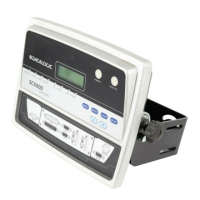
The SC5100 is compatible with many devices. The following typical layouts refer to sys-
tem hardware configurations, but also require the correct setup of the software config-
uration parameters. Not all of the possible configurations can be illustrated here. Other
layouts may require the use of a specific SC5100 Controller model.
The accessories and cables indicated in the following figures are Datalogic products. We
suggest their use to guarantee the correct system functioning.
It is important to follow these guidelines:
• Make sure to leave adequate clearances for wiring 300 mm (12in)
• Route wires carefully to reduce or minimize electrical noise
• When extraneous power and communication wiring must cross make there inter-
section perpendicular
• Do not run power and data wiring parallel to each other
• If possible separate power and data
• 6.5 mm (.25 in) of aluminum use steel conduit and 25 mm (1 in.) gap
Large Synchronized Network Layout
An SC5100 can be used when building a large local EBC (Ethernet Based Connectivity)
network. The SC5100 unit acts as the system master and is connected to the host
through one of its interfaces.
• The SC5100 can be connected to the Host in several different layouts depending
on the controller model.
• The SC5100 Standard models provide both Ethernet and SyncNet connections
• Point-to-point connections are available using either RS232 or RS422 full-duplex;
Fieldbus models, additionally provide the model specific Fieldbus: Profibus, Prof-
inet
External devices such as a presence sensor and an encoder are all connected either to
the CBX100, CBX510 or CBX800 connection box (connected to the SC5100), wiring the
signals through the CBX510 compression connectors.


 To Next Page