MAINTENANCE 10
AXH1157-UK (ENG) L3500 L4700 F7000 [FPT S3A] 103
• Each recharge will be good as good are the
general conditions of the battery. This means that
an old battery, after charging, will not have the
same life and efficiency of a new battery.
• The simplest charging method is to charge at
constant power.
• At the end of the charging, the battery charger
voltage increases and creates gasification. It is
recommended to use simple battery chargers
with minimum current control and timer.
• If the battery has a low electrolyte level restore it
to the minimum level (just above the plates limit)
then charge them. After the charging is
completed, fill to the maximum level (to prevent
leakage).
• Overcharging must be avoided because:
– It is a loss of energy which causes the
dissociation of water.
– It produces loss of active mass for the
electrodes deterioration
– It creates a risk of explosion.
• If sulfated batteries are recharged without
voltage limitation, they will boil and warm up
with a risk of explosion.
• For old batteries (in most cases sulfated) charge
with great caution. Even with 13.8 Volts there is
the possibility of a temperature increase.
Follow these instructions to recharge the
battery:
1. Disconnect the cables of the vehicle from the
battery to protect the electrical system of the
vehicle.
2. Place the battery at a safe distance from the
vehicle.
3. If possible, remove the caps.
4. Check the electrolyte level, if possible.
5. Clean the poles.
6. Make sure the room is sufficiently ventilated.
7. Limit the charging current to a maximum of 1/10
of the battery capacity (Ah).
8. Connect the battery to the charger.
9. Connect the charger to the mains.
10. Turn on the battery charger.
11. The battery temperature must not exceed 55°C.
12. After finishing switch off the battery charger.
13. Disconnect the battery charger from the mains.
14. Disconnect the battery from the charger.
15. Check the electrolyte level, if possible.
16. Refit the caps.
10.4.4 - Battery isolation switch
WARNING
Use this switch only when the engine is stopped.
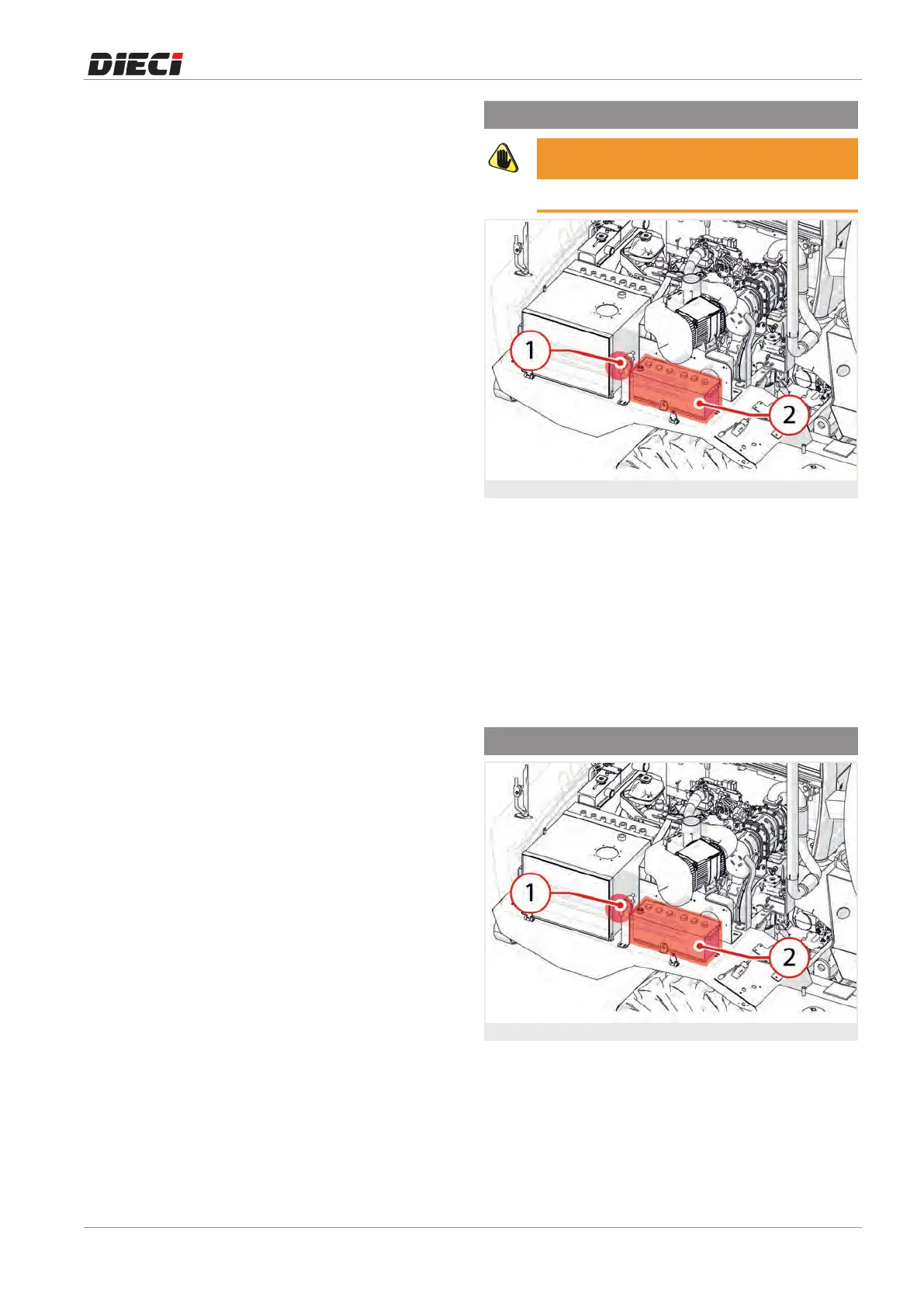
Figure: 150731-1
The battery isolation switch "1" (150731-1) allows the
operator to isolate the battery from the electrical
circuit in case of emergency or during maintenance
operations.
To isolate the battery:
• Turn off the engine.
• Turn the ignition key to position "0".
• Turn the battery isolation switch
counterclockwise to the off position.
10.4.5 - Battery: Replacement
Figure: 150732-1
The vehicle is equipped with a battery located inside
the engine hood “2” (fig. 150732-1).
Before removing the battery disconnect it from the
electrical circuit through the appropriate battery
isolation switch, following the instructions given in
the relevant chapter.
To remove the battery:



 To Next Page