4
SAFETY REGULATIONS
28 AXH1157-UK (ENG) L3500 L4700 F7000 [FPT S3A]
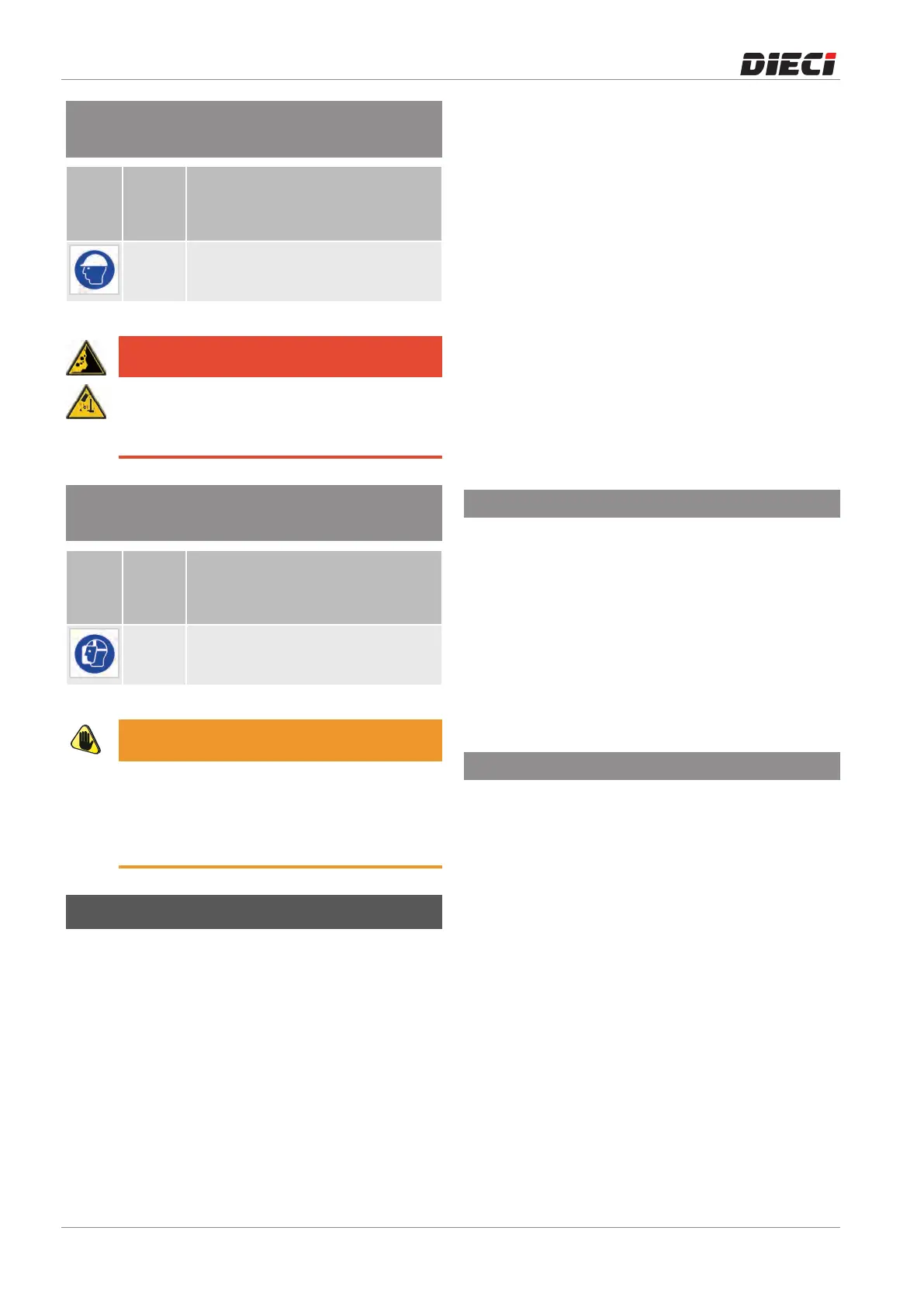
4.3.3 - Protections against objects
falling from height
Icon
Reference
Description
ISO7010:
M014
Wear a helmet
DANGER
Danger of falling objects
Use of a safety helmet is required if there is a risk
of falling objects.
4.3.4 - Protect yourself from flying
fragments
Icon
Reference
Description
ISO7010:
M013
Wear a face shield
WARNING
During operation in certain conditions, particles
of material may be ejected. In such conditions, it
is a good idea to wear protective goggles and
clear the area of those people not in possession of
such goggles.
4.4 - Preparing for accidents
• Always be prepared in the event of a fire or an
accident.
• Keep a fire extinguisher and first aid kit at hand.
(Not supplied by the manufacturer, "optional
accessories").
• Carry out periodic inspections to ensure that the
first aid kit contains all necessary items; replenish
content if necessary.
• To properly use the extinguisher, carefully read
the instructions located on the extinguisher.
• Carry out periodic inspections and maintenance
(six monthly) to ensure that the extinguisher is
ready for use at any given moment.
• Create priority procedures to deal with fires or
accidents.
• Keep emergency telephone numbers (doctors,
ambulance, hospital and fire brigade) clearly
visible and near the telephone.
• Adequately trained and educated personnel must
be present for managing emergencies with
adequate theoretical-practical course carried out
on site.
Below are some First Aid procedures that can be
activated in case of accident following use of the
vehicle or equipment object of this use and
maintenance manual.
These procedures may be useful in an emergency for
the users or other operators present near-by, during
use and various life phases of the vehicle or of the
equipment (transport, installation, use, maintenance,
adjustment, etc.).
4.4.1 - First Aider Tasks
1. Activate first aid (emergency call).
2. Evaluate the victim and, if necessary, support vital
functions.
3. Stop an external hemorrhage.
4. Protect wounds and burns.
5. Protect the victim against further damages.
6. Do not perform unnecessary or damaging
actions, such as giving beverages, moving the
victim, reducing dislocations and/or fractures, etc.
4.4.2 - Emergency call
Good first aid intervention also depends on the timely
arrival of rescuers (emergency medical support) to the
place of the emergency.
This is why the first aider in charge of calling the
emergency must precisely indicate:
• Address of where the accident or illness took
place.
• Number of injured or ill persons.
• The possible cause of the event.
• The state of the vital functions of the injured
party, specifying whether the same is conscious
or not and breathes normally or not.
At the end of the call it is recommended to:
• Give own details, indicating a telephone number
where to be contacted.
• Wait for rescuers in an easily accessible and visible
location.



 To Next Page