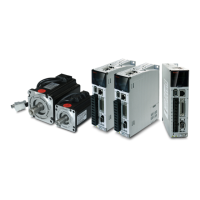
Kinco FD5 AC series servo driver user manual
Chatper 10 Communication
Table 10-17 Setting Velocity mode through SDO message
Send→601 2F 60 60 00 03 00 00 00
Receive←581 60 60 60 00 03 00 00 00
Send→601 23 FF 60 00 7E B1 E4 FF
Receive←581 60 FF 60 00 7E B1 E4 FF
Send→601 2B 40 60 00 2F 00 00 00
Receive←581 60 40 60 00 2F 00 00 00
Send→601 23 83 60 00 6E A3 01 00
Receive←581 60 83 60 00 6E A3 01 00
Send→601 23 84 60 00 6E A3 01 00
Receive←581 60 84 60 00 6E A3 01 00
Note: The message is expressed in hexadecimal, and the resolution of the motor used in this case is 65536
PDO description
PDO can transmit 8 bytes of data at a time, with no other protocol presetting (meaning that the data content is predefined),
and is mainly used to transmit data requiring high frequency exchange. The transmission mode of PDO breaks the existing data
question-and-answer transmission concept and adopts a new data exchange mode. The two sides of the device define the data
receiving and sending area in each device before transmission, and directly send the relevant data to the data receiving area of
the other side during data exchange, which reduces the question-and-answer inquiry time and greatly improves the efficiency of
bus communication. As a result, high bus utilization is achieved.
PDO's COB-ID description
COB-ID is a unique method of CANopen communication protocol, its full name is Communication Object Identifier-
communication object-ID, These COB-IDs define the corresponding transmission levels for the PDO. With these transmission
levels, the controller and the servo can define the same transmission level and the transmission content in their respective
software configurations. In this way, after both the controller and the servo use the same transmission level and transmission
content, the data transmission is transparent, that is, both parties know the content of the data to be transmitted, and there is no
need for the other party to reply data when transmitting data.
The default ID allocation table is based on the 11-bit CAN-ID defined by CANopen 2.0A
(CANopen 2.0B protocol COB-ID is 27 bits), including a 4-bit function code part and a 7-bit node ID (Node-ID) section,
as shown in Figure 10-4.
Figure 10-4 Default ID explanation diagram
Node-ID ——Defined by the system integrator, for example, set by the DIP switch on the device (that is, the station number of
the servo), the Node-ID range is 1~127 (0 is not allowed to be used)
;
Function Code
——
The function code of data transmission defines the transmission level of various PDOs, SDOs, and
management messages. The smaller the function code, the higher the priority.
Table 10-18 CANopen predefined master/slave connection set CAN identifier assignment table
Broadcast object for CANopen predefined master/slave connection set
Function code
(
ID-bits 9-7
)
Index of communication parameters
in OD
Peer object for CANopen master/slave connection set
Function code(ID-bits 9-7)
Index of communication parameters
in OD


 To Next Page
 Loading...