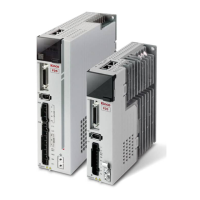
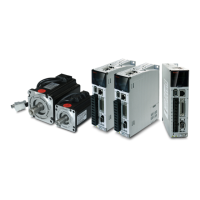
Kinco FD5 AC series servo driver user manual
Chatper 10 Communication
Note:
1.The smaller the COB-ID, the higher the priority;
2.The function code in front of each level of COB-ID is in a fixed format;
3.COB-IDs are 00H, 80H, 100H, 701H-77FH, and 081H-0FFH, which are all system management formats.
FD5 series servo drive supports COB-ID
Send PDO
(
TXPDO
)
TXBDO refers to the data sent by the servo relative to the servo, and these data are received by the PLC. The function code
(COB-ID) for sending PDO is:
1
、
0x180+Servo station NO.
2、0x280+ Servo station NO.
3、0x380+ Servo station NO.
4、0x480+ Servo station NO.
Receive PDO
(
RXPDO
)
Compared with the servo, the receiving PADO refers to the data received by the servo. These data are sent by the PLC. The
function code (COB-ID) of the sending PDO is:
1、0x200+ Servo station NO.
2
、
0x300+ Servo station NO.
3
、
0x400+ Servo station NO.
4
、
0x500+ Servo station NO.
PDO transmission type
PDO has two different transmission type
:
Synchronize
(
SYNC
)——
Transmission triggered by synchronization messages
(
Transmission type
:
0-240
)
In this transmission mode, the controller must have the ability to send synchronization messages (messages sent periodically
with a frequency of up to 1KHZ), and the servo will send the synchronization message after receiving the message.
Period - The transfer type is 1-240. Delivery is triggered after every 1 to 240 SYNC messages. In this mode, the data in the
PDO is sent once every time the servo drive receives n synchronization messages.
Asynchronous (Transmission Type: 254/255)
The message is sent after the slave message data has changed, regardless of whether the master asks it or not. And can define
the time interval between two transmissions of the same message to avoid high priority messages occupying the bus all the time
(the lower the PDO value, the higher the priority).
The transmission PDO(TPDO) of the FD5 series servo drive supports synchronous and asynchronous transmission modes,
and the corresponding transmission type can be selected according to the transmission mode. For receiving PDO(RPDO), when
the driver node is enabled in non-interpolation mode, the object data will be received in real time as long as the RPDO packets
from the bus are detected, regardless of the transmission type setting. In interpolation mode, the driver receives data after


 To Next Page
 Loading...