5
LeeBoy 8616B Conveyor Paver 5-13
Generator Voltage Testing
The generator is hydraulically-driven. When the paver
engine is at 1600 RPMs and the hydraulic system is at
normal operating temperature, the generator should
produce between 220 VAC and 240 VAC.
The generator voltage depends upon speed (RPMs),
increasing voltage as RPMs increase and decreasing
voltage as RPMs decrease. The voltage will decrease
signicantly if the generator speed is slower than 3480
RPMs.
NOTE: When testing the generator voltage ensure the
paver engine is at 1600 rpm and the hydraulic
temperature is at normal operating levels.
To test the generator voltage:
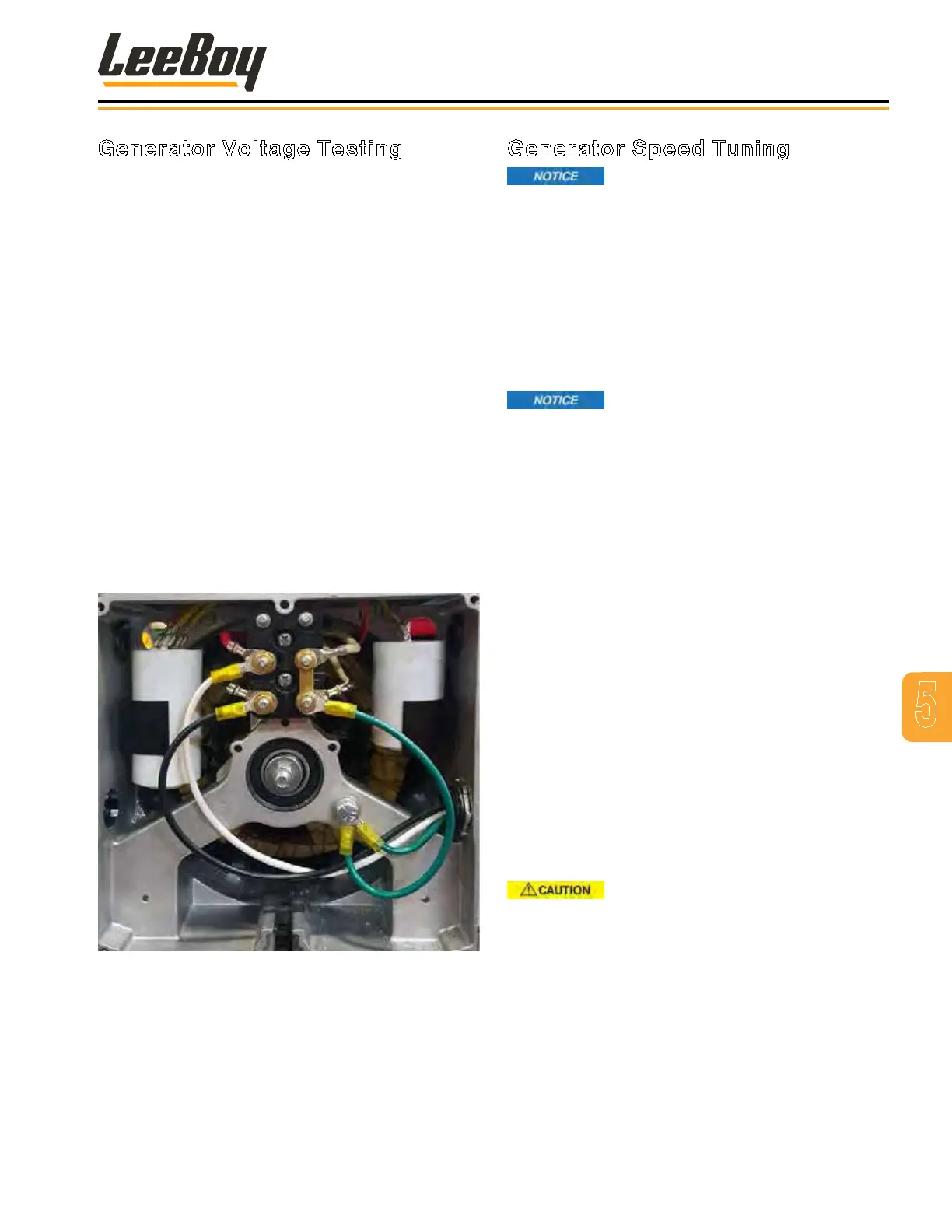
1. Use volt meter to measure between the two main
input wires L-1 (black wire) and L-2 (white wire).
(Figure 5-13)
2. If you measure from L-1 to the frame of the paver, or
ground, the voltage will be half the rated output of
the generator. The voltage should be the same as
measured at the control box.
Figure 5-13. Generator
If the voltage is lower, make certain the generator is
turning the correct speed by testing with a Hz meter or
photo tachometer.
Generator Speed Tuning
This adjustment should only be
performed by an authorized LeeBoy dealer. Work
not performed by an authorized dealer can damage
machine and void the warranty.
A voltmeter set to read frequency (Hz) can be used to
test generator speed. When the engine is running at
1600 RPMs, the generator should operate at 58 to 62
Hz, or a speed of 3480 to 3720 RPMs. If the generator
speed drops below 3480 RPMs, the voltage output
and performance of the heating system will decrease
signicantly.
The generator should never be
operated at a speed of 3800 RPMs or greater.
Generator damage will occur and void your warranty.
Your authorized LeeBoy dealer will perform the
following procedure:
1. Remove back panel from generator housing to
access the rear of the generator.
2. Set voltmeter to read frequency (Hz), to measure
between the two main input wires L1 and L2. (Figure
5-12) A photo tachometer may also be used to
check the speed of the generator at the motor
coupling by removing the motor coupling shield.
NOTE: When testing the generator speed, make
certain that the paver engine is at 1600 rpm
and the hydraulic temperature is at normal
operating levels.
3. Note that 60 Hz is exactly 3600 RPMs. For every
Hz above 60, an increase of 60 RPMs can be added
to 3600 RPMs. For every Hz below 60, a decrease
of 60 RPMs can be subtracted from 3600 RPMs.
Example: 60 Hz is 3600 RPMs. A reading of 62 Hz
would be 3720 RPMs. A reading of 58 Hz would be
3480 RPMs.
Always replace shields and panels
when nished testing.


 To Next Page