262335 119 Revision A
5.14 Running up Header
DANGER
To prevent injury or death from the unexpected start-up of the machine, always stop the engine and remove the key
from the ignition before leaving the operator’s seat for any reason.
DANGER
Ensure that all bystanders have cleared the area.
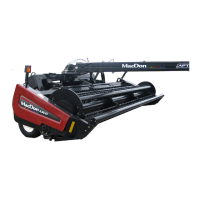
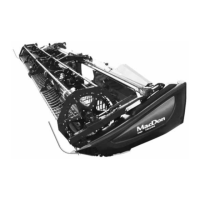
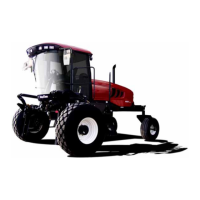
1. Start windrower and operate header slowly for 5 minutes, watching and listening FROM THE WINDROWER SEAT for
binding, interfering parts, or unusual noises.
2. Run the machine for 15 minutes at maximum engine operating rpm and perform the run-up check as listed on the
Predelivery Checklist (yellow sheet attached to this manual – Predelivery Checklist, page 145) to ensure machine is
field-ready.
3. Proceed as follows:
• M Series Windrower: To calibrate knife drive, refer to the M Series operators manual.
• M1 Series Windrower: Proceed to Step 5.14.1 Calibrating Knife Drive, page 119.
• M2 Series Windrowers: Proceed to Step 5.14.2 Calibrating Knife Drive on HarvestTouch
™
Display, page 121 .
5.14.1 Calibrating Knife Drive
A total of nine stages is involved in the knife drive calibration with checks at three knife drive flows at three different
engine speeds.
The calibration is done at three knife drive flows:
• Low flow – an estimate amount of flow required to reach the minimum adjustable speed for the attached header
• Medium flow – an estimate amount of flow for the knife speed in between the minimum and maximum adjustable
speed for the attached header
• High flow – an estimate amount of flow for the maximum adjustable speed for the attached header
The three knife drive flows are done at three engine speeds – 1800, 2000, and 2300 rpm.
DANGER
Ensure that all bystanders have cleared the area.
1. Start the windrower, and engage the header.
PERFORMING PREDELIVERY CHECKS


 To Next Page