REPAIR INSTRUCTIONS, PART 1
Page 123
Turbocharger Removal
[214 SC]
131
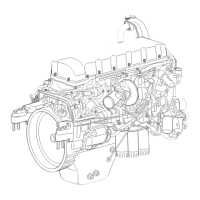
Figure 131 — Turbocharger with Actuator
The turbocharger is heavy. Do NOT attempt to
remove the turbocharger without the help of
an assistant or the use of a suitable lifting
device. Failure to heed this warning may
result in severe personal injury and
component damage.
Thorough cleanliness is required. Small particles
can cause severe rotor damage if inducted during
high-speed operation. Be sure to plug the inlet
and outlet ports while handling the turbocharger.
Failure to heed this caution may result in severe
component damage.
1. Install and retain the protective caps over the
turbocharger ports to keep debris and dirt
out of the turbocharger.
2. Remove the turbocharger coolant supply
line.
3. Remove the turbocharger coolant outlet line.
4. Remove the oil supply line.
5. Remove the oil outlet line.
6. Remove the actuator coolant return line.
7. Remove the actuator coolant supply line.
8. While supporting the turbocharger, remove
the flange mounting fasteners and spacers.
9. With the help of an assistant or a lifting
device, lower the turbocharger away from
the exhaust manifold flange mounting studs
and remove it from the engine. Remove and
discard the gasket.
EGR Hot Pipe (Cooler Inlet)
Removal
[214 HN, HP, HR]
The hot pipe is the short connector between the
EGR valve and the EGR cooler inlet.
Whenever an EGR hot pipe clamp is removed,
the retaining nut may gall the threads of the
T-bolt. The body of the clamp can be reused and
should not be replaced unless broken or
damaged.
1. Loosen the high temperature V-clamps at
the EGR hot pipe by removing the nuts from
the T-bolts. Free the clamps from the EGR
hot pipe flanges.
2. Remove the EGR hot pipe from between the
EGR valve and the EGR cooler.
1. Actuator Coolant Supply
Line
2. Actuator Coolant Return
Line


 To Next Page