M A E D A Mini-Crawler Crane Section 4 – CRANE OPERATION
9/2020 MC285CB-3 4-63
Monitor (Only During Crane/Outrigger
Operation)
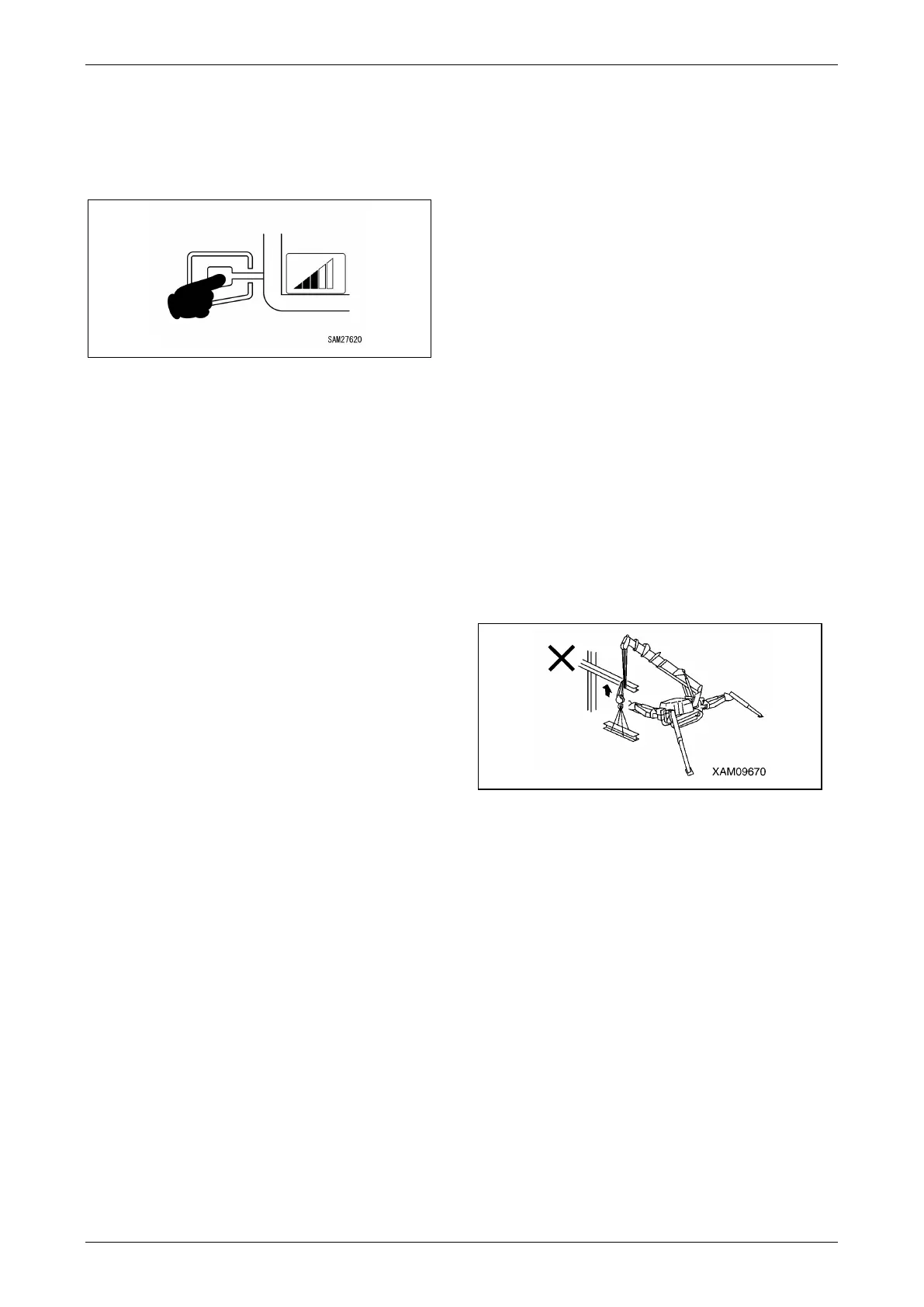
Pressing the motor speed adjuster switch
increments the motor speed in five steps.
Fig. 4-159
Radio Remote Control (Only When
Operating under Radio Remote Control)
There is no motor speed adjuster switch. Vary the
speed using the control levers.
Hook Raising / Lowering
Operation
WARNING! The following safety messages
address a potential Crush Hazard while
operating the crane or boom:
• Verify that all personnel are a safe distance
away from the hoisted load once the load
starts to be hoisted. The boom can deflect
once a load starts to be hoisted. This will
cause the load to shift slightly forward.
WARNING! The following safety messages
address a potential Sudden Movement Hazard
while hoisting or lowering a load:
• Always remain seated in the operating
position when a load is hoisted. Lower the
load before leaving the machine.
• Always position the hook above the centre
of gravity of the load before hoisting. When
the load leaves the ground, stop hoisting
and check whether the load is stable. If
unstable, lower the load to the ground and
readjust the position of the hook to stabilise
the load while hoisting. Be sure the load is
stable before continuing to hoist the load.
• Do not hoist more than one load at a time.
Even if the load is within the rated total load
limit, multiple loads may be unstable once
they are hoisted. Only hoist one load at a
time and be sure it does not exceed the rated
total load limit.
• Always hoist a load in the shortest length
possible. Hoisting a load over a lengthy
distance may cause the load to become
unbalanced. Use extreme caution if a load
must be hoisted over a lengthy distance.
Hoist the load in as vertical a manner as
possible. Use additional methods, such as
applying a rope to both ends of the load, to
maintain balance.
• Verify that a load connected to a sling or
other retainer device (other than the hook
block) is secure before hoisting the load.
Before hoisting the slung load, check
whether the load is taught with the hook
block. Hoisting a slung load that is not
taught with the hook block may cause the
slung load to detach from the hook block
and fall once the slung load is hoisted.
Fig. 4-160
• Do not hoist a load by pulling it sideways,
drawing it in, or hoisting it diagonally or
laterally using the boom. These conditions
may cause unreasonable force on the
machine and uncontrollable movement of
the load. Only hoist the load when the hook
block and wire rope cable are perpendicular
to the ground.


 To Next Page