The optoNCDT 1700 and optoNCDT 1710 are laser-optical sensors designed for precise displacement, distance, position, and elongation measurements in industrial applications. They utilize the principle of optical triangulation, projecting a visible, modulated point of light onto the target surface. The reflected light spot is then imaged by a receiver optical element onto a high-sensitivity CCD element. A digital signal processor (DSP) within the sensor calculates and linearizes the distance, which is then output via an analog or digital interface.
Function Description:
The core function relies on optical triangulation. For diffuse reflection, the sensor projects a laser spot, and the diffuse reflection is captured by the CCD. The DSP processes this signal to determine the distance. For direct reflection, particularly useful for shiny or mirroring surfaces like glass, the direct reflection of the laser spot is imaged. Specific models (ILD1700-2DR, ILD1700-10DR, ILD1700-20DR) are calibrated for tilted positions to handle direct reflection effectively.
A key feature is the Real Time Control (RTC), which uses the CCD signal to determine the intensity of diffuse reflection. This allows the sensor to compensate for brightness fluctuations on the measured object, handling a wide range from almost total absorption to total reflection. Exposure Control manages the laser exposure time, which can be adjusted manually or by command, especially for dark or shining objects, by reducing the measurement frequency.
The sensor operates in a pipeline mode for measurement value flux, involving exposure, reading, computation, and controlling cycles. Each cycle takes 400 µs at a 2.5 kHz measuring rate, resulting in a constant lag of four cycles between the real-time event and the measurement value availability.
Important Technical Specifications:
The optoNCDT 1700 series offers various models with different measuring ranges, from 2 mm to 750 mm for diffuse reflection, and 2 mm to 50 mm for direct reflective surfaces (DR models). The optoNCDT 1710 series extends this to long distances, with measuring ranges of 50 mm and 1000 mm.
- Measuring Range: Varies by model (e.g., ILD 1700-2: 2 mm; ILD 1700-750: 750 mm; ILD 1710-1000: 1000 mm).
- Linearity: Typically ±0.1% FSO, with some models achieving ±0.08% FSO or ±0.25% FSO. DR models have linearity of ±0.1% FSO to ±0.2% FSO.
- Resolution: Ranges from 0.1 µm (ILD 1700-2) to 100 µm (ILD 1710-1000) at 2.5 kHz without averaging.
- Measurement Frequency: Programmable at 2.5 kHz (1), 1.25 kHz (1/2), 625 Hz (1/4), and 312.5 Hz (1/8).
- Light Source: Semiconductor laser, 670 nm (red) for ILD 1700, 405 nm (blue-purple) for ILD 17x0BL models, max. power 1 mW, Laser Class 2.
- Operating Temperature: 0 to +50 °C (0 to +55 °C for ILD1700-250VT).
- Storage Temperature: -20 to +70 °C.
- Protection Class: IP 65 (with sensor cable connected, lenses excluded).
- Power Supply: 24 VDC (11-30 V), max. 150 mA.
- Measurement Value Output: Selectable 4-20 mA, 0-10 V, or RS422.
- Switching Outputs: Programmable for error or limit values, short-circuit proof.
- Synchronization: Programmable for simultaneous or alternating operation.
- Weight: Varies by housing size (S, M, L), from 550 g to 800 g (with 25 cm cable).
Usage Features:
- Mounting: Sensors are mounted using screws to existing holes on a flat surface. Proper alignment, with the laser beam directed perpendicularly to the target, is crucial for accurate measurements. Specific dimensional drawings and free space requirements are provided for different models.
- Operation Modes: The sensor supports "Error Mode" (error control) and "Switch Mode" (limit control). In error mode, switching output 1 indicates errors (object outside range, no object, unsuitable object). In switch mode, both outputs act as limit switches with programmable upper/lower limits and hysteresis values.
- Averaging: Offers "Moving Average," "Recursive Average," and "Median" methods to improve resolution, eliminate signal spikes, and smooth the signal. Averaging numbers (N=1, 4, 32, 128) can be set via membrane keys or the digital interface.
- Mastering and Mid-point Setting: "Mastering" allows comparison of measurement values with a known master object, displacing the sensor's characteristic curve. "Setting Mid-Point" displaces the analog measurement value to the mid-point of the range. Both can be activated via sensor buttons, external signals, or serial commands.
- Synchronization of Sensors: For multi-sensor setups, simultaneous or alternating synchronization prevents optical interference, especially for thickness measurements or closely spaced measurement points.
- Triggering: Measurement output can be controlled by an external signal (electrical or command) based on rising edge, falling edge, high level, or low level trigger conditions.
- Serial Interface RS422: Enables operation from a standard computer, transferring measurement values and error codes. Supports binary and ASCII data formats, with programmable baud rates.
- ILD1700 Tool Software: A dedicated software for configuration, measurement data acquisition, evaluation, and storage.
Maintenance Features:
- Cleaning: The sensor should be switched off for cleaning and maintenance.
- Protective Housing: Recommended for dirty environments or higher ambient temperatures to protect the sensor. Specific guidelines for protective housings include temperature limits, compressed-air requirements (for air purging models), and cleaning recommendations for the protective window.
- Repair: For repair or service, sensors must be sent to the manufacturer. Users are advised to save current sensor settings before sending for repair.
- Disposal: The device, its components, and packaging materials must be disposed of in compliance with applicable country-specific waste treatment and disposal regulations.

 Need help?
 General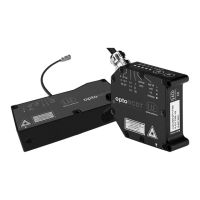

 To Next Page