Page 13
Functional Principle, Technical Data
optoNCDT 1700
3.1.2 Direct Reflection
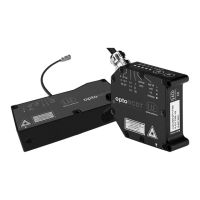
The optoNCDT1700DR consists of an laser-optical
sensor and a signal conditioning electronics. The
sensor uses the principle of optical triangulation, i.e.
a visible, modulated point of light is projected onto
the target surface. The direct element of the reflec-
tion of the light spot is imaged by a receiver optical
element onto a high-sensitivity resolution element
(CCD), in dependency on distance. From the output
signal of the CCD element a digital signal processor
(DSP) in the sensor calculates the distance between
the light spot on the object being measured and the
sensor. The distance is linearized and then issued
via an analog or digital interface.
On shining or mirroring surfaces the direct element
of the reflection of the laser spot is greater and cov-
ers therefore the diffuse part. Suppression of the
2
nd
reflection from the glass rear side in the sen-
sor is possible for measurements on glass panels.
Sensors for direct reflection (ILD1700-2DR, ILD1700-
10DR and ILD1700-20DR) are calibrated in tilted
position. Therefore the can not be used for diffuse
reflection.
Sensor
ILD1700DR
Analog output
0 VDC 4 mA
5 VDC (MMR) 12 mA
10 VDC (EMR) 20 mA
Measuring range
Midrange
Fig. 3 Definiton of terms, output signal
3.2 Real Time Control
The signal from the CCD element is used to determine the intensity of the diffuse reflection. This enables the
sensor to compensate for fluctuations in brightness on the object being measured. What is more, it does so
in a range from almost total absorption to almost total reflection.
SMR = Start of
measuring range
MMR = Midrange
EMR = End of
measuring range


 To Next Page