Getting Started
893-00992-E
1-11
Port Mirroring
The Port Mirroring feature (sometimes referred to as conversation steering)
allows a user to designate a single switch port as a traffic monitor for up to two
specified ports or two media access control (MAC) addresses.
You can specify port-based monitoring, where all traffic on specified ports is
monitored, or address-based monitoring, where traffic between specified MAC
addresses is monitored.
You can attach a probe device (such as a Nortel Networks StackProbe
™
, or
equivalent) to the designated monitor port. The designated port can monitor all
traffic on the network segment connected to the mirrored port. Error packets can
also be monitored and copied to the mirrored port for network troubleshooting.
For more information about the mirroring feature, see “Port Mirroring
(Conversation Steering)” on page 1-45.
Flash Memory Storage
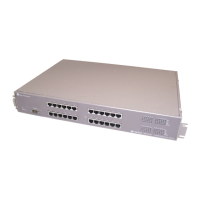
The BayStack 350 switch uses flash memory to store the switch software image.
Flash memory allows you to update the software image with a newer version
without changing the switch hardware.
An in-band connection between the switch and the TFTP load host is required to
download the software image (see “Software Download” on page 3-71).
For information about connecting a console terminal for this procedure, see
“Console/Service Port Cabling” on page 3-2.
Note:
If a BootP server is set up properly on the network and the BayStack
350 switch detects a corrupted software image during the self-test, the switch
automatically uses TFTP to download a new software image.





 To Next Page