Instrument Functions
R&S
®
NRP2
98User Manual 1173.9157.02 ─ 03
4.4.3 Selecting a measurement function
In this chapter, measurement function are discussed that can be displayed in numeric
windows ("Dig", "D/A"). The functionality of the graphic windows is described in chap-
ter 4.5, "Displaying traces", on page 112
The R&S NRP2 can display the measurement result of one channel (sensor) or combine
measured values from two channels (sensors) using a mathematical function and display
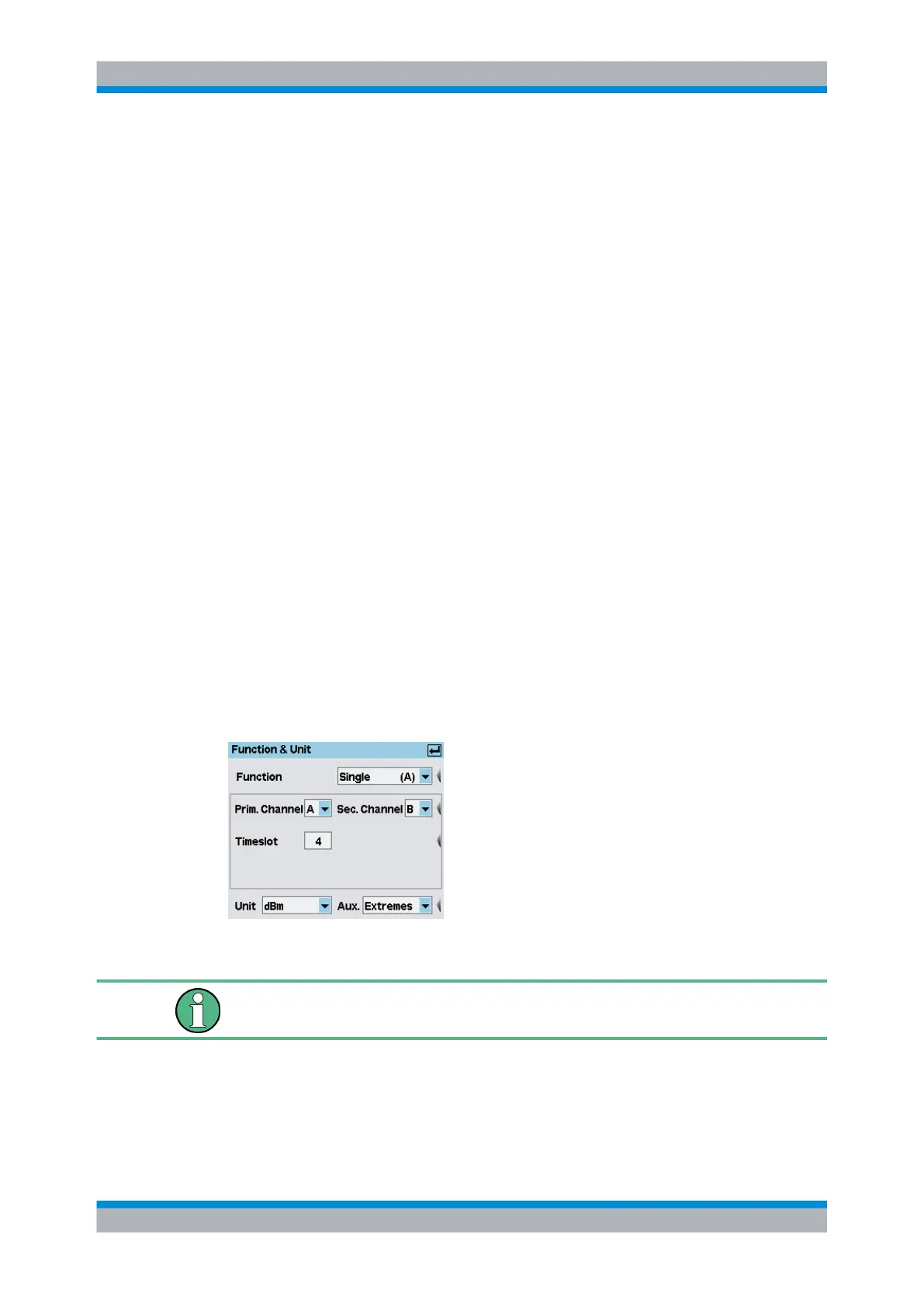
the result in the selected window. The necessary settings are made in the "Function..."
dialog box.
The first step is to select the measurement function, i.e. the mode of combination for multi-
channel measurements. Possible functions are the power ratio, the sum, or the difference
of two channels, an impedance matching measurement function derived from the power
ratio or the power in a single measurement channel. All or any of the connected sensors
can be selected. A primary channel, and possibly a secondary channel, must be selected
for each measurement window.
The simplest case is a measurement with just one sensor. To configure this measure-
ment, first select this sensor in the "Prim. Channel" list. Then select "Single (x)" as func-
tion.
To make two-channel measurement, a "Sec. Channel" must be defined prior to selecting
the measurement function.
For impedance matching measurement functions ("SWR (x,y)", "RCoeff (x,y)" and
"RLoss (x,y)"), the first letter (x) is always referenced to the channel detecting the "Inci-
dent power" and the second letter (y) to the channel detecting the "Reflected power".
"Prim. Channel" and "Sec. Channel" are replaced by "Incident" and "Reflected" in this
case.
Any of the four channels A, B, C, and D can be assigned primary or secondary channel.
Fig. 4-29: Function & Unit dialog box
The parameters provided in the middle of the dialog box vary according to the selected
measurement mode.
4.4.3.1 Functions and their use
In the "Function & Unit" dialog box of the "Measurement" menu, select the measurement
function, the associated sensor channels, the unit, and additional readings for the display.
Configuring measurements


 To Next Page