Remote Control - Commands
R&S
®
NRP2
328User Manual 1173.9157.02 ─ 03
TRIGger<[1]..4>:DELay <delay>
TRIGger:ALL:DELay <delay>
Defines the delay between the trigger event and the beginning of the actual measurement
(integration).
Parameters:
<delay> float_value
Range: depending on sensor
*RST: depending on sensor
Default unit: S
TRIGger<[1]..4>:
DELay:AUTO <state>
TRIGger:ALL:DELay:AUTO <state>
TRIG:DEL:AUTO ON makes certain that a measurement is not started until the sensor
has settled. To this end, the delay value is automatically determined. This is especially
important when thermal sensors are used. The automatically determined delay is ignored
if a longer period is set with TRIG<[1]..4>]:DEL.
Parameters:
<state> ON | OFF
*RST: depending on sensor
TRIGger<[1]..4>:DTIMe <dtime>
TRIGger:ALL:DTIMe <dtime>
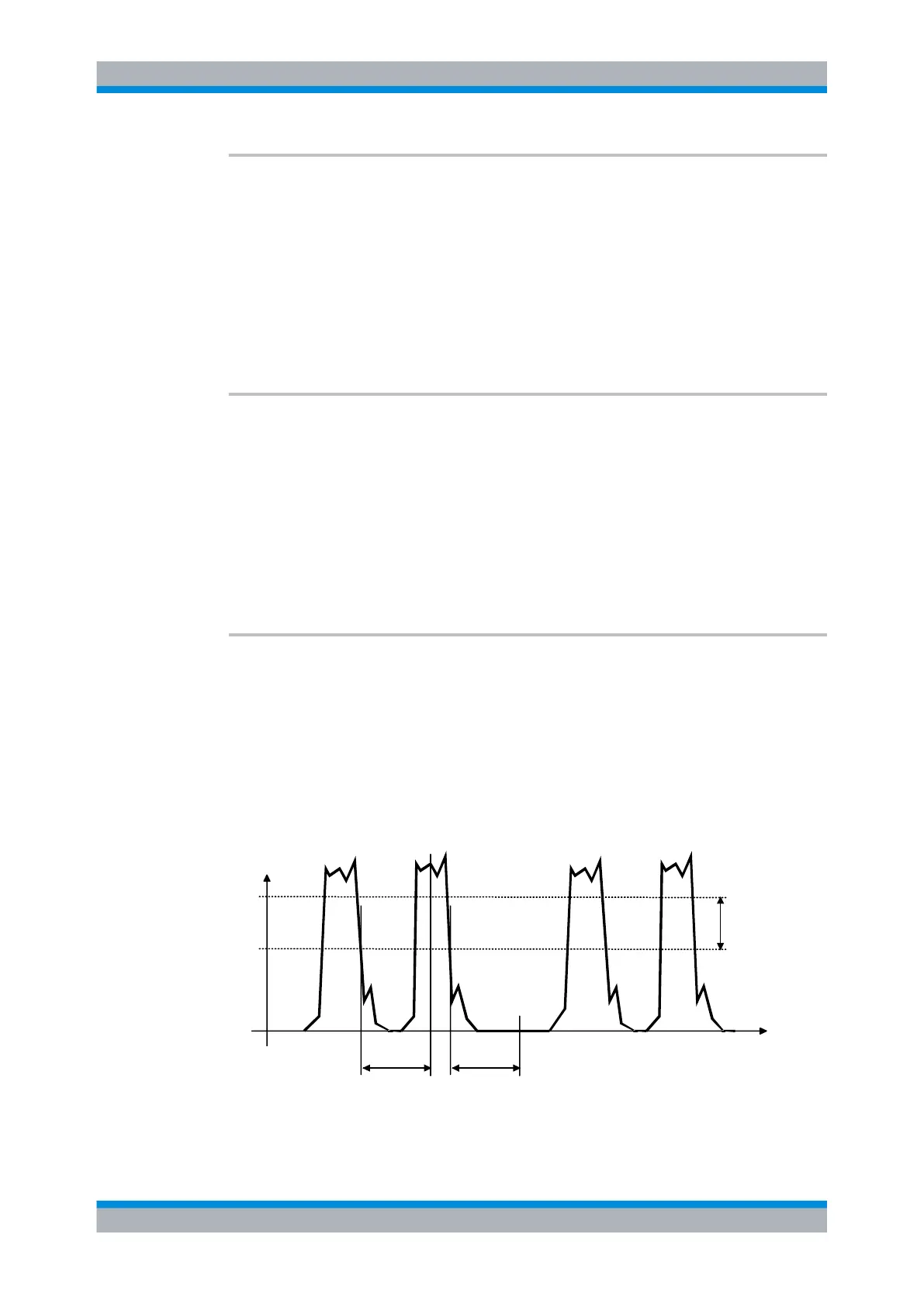
If the trigger level has been underrun with internal triggering, it is sometimes useful to
wait some time (drop-out time) before retriggering. The measurement of unwanted signal
components can thus be suppressed. This setting parameter is used with pulsed GSM
signals, for example, if only specific timeslots are to be measured.
The figure below shows the importance of the drop-out time. If the timeslots BF and DH
are not to be measured, the drop-out time is set to a higher value than the period EB
(GD). In this case, the trigger events B and D are ignored.
Trigger level
Power
Time
Drop-Out
Time
Trigger hysteresis
A B C D
E F G H
Drop-Out
Time
Fig. 6-20: Significance of the drop-out time parameter
TRIGger


 To Next Page