Programming Measurements
R&S
®
NRP2
385User Manual 1173.9157.02 ─ 03
C.3 Logic relationship of command systems SENSe, CAL-
Culate and UNIT
The following section provides an overview of the measurement procedure of the
R&S NRP2. The commands are mentioned as examples. These commands are descri-
bed in detail in chapter 6, "Remote Control - Commands", on page 191.
To perform measurements with the R&S NRP2, the user should have a good under-
standing of the trigger system and be familiar with the result processing. The measured
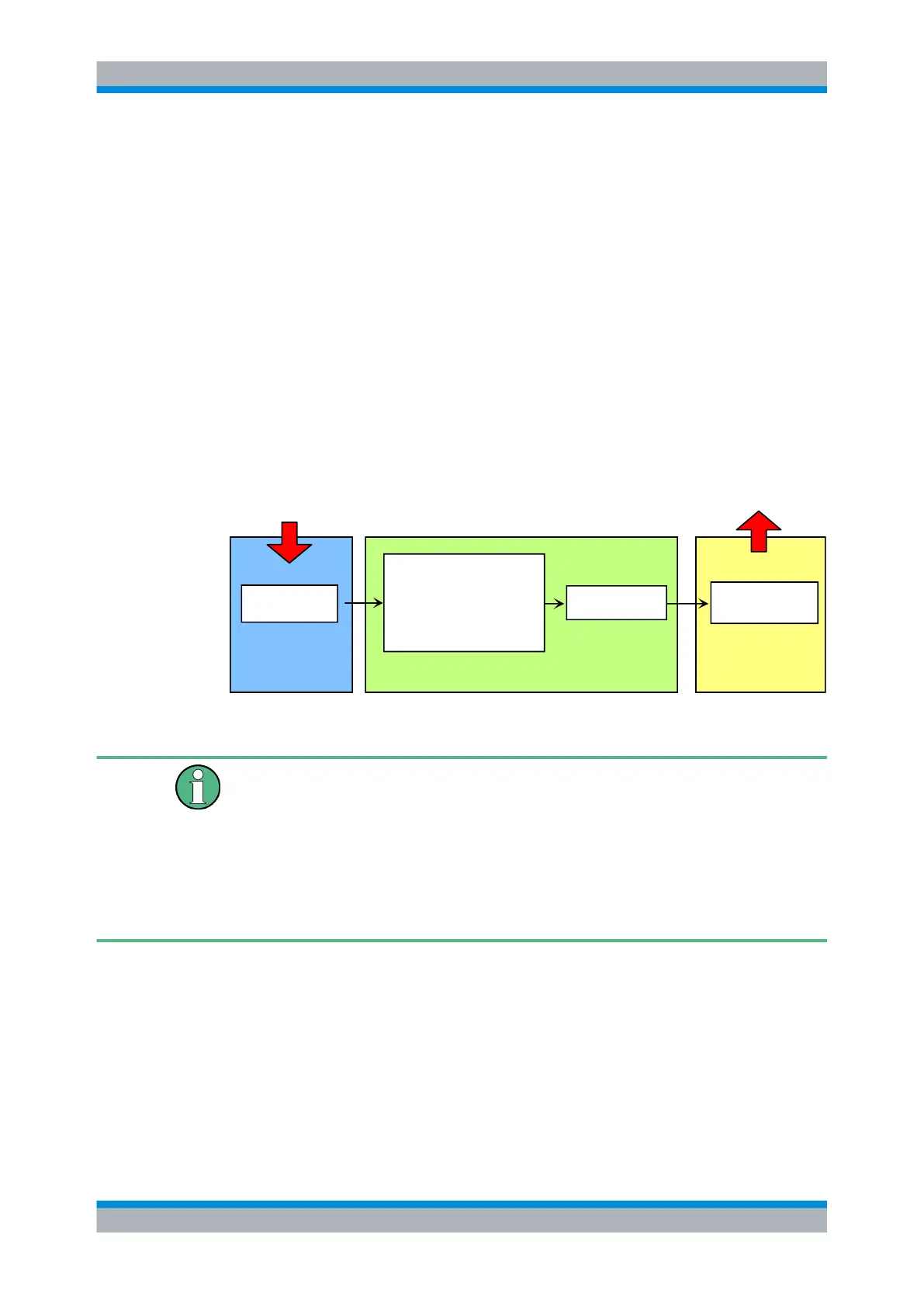
values delivered by the sensors cannot be directly queried. As shown in figure below, the
raw data is first determined in the sensors taking into account the SENSe settings. It is
then transferred to the CALCulate blocks where the measured values of up to two sen-
sors are processed and made available to the user in the unit defined by UNIT.
CALC[1..8]:MATH:EXPR
- "SENSn"
- "SENSn - SENSm"
- "SENSn / SENSm"
- "REFL"
- "SWR
- "RLOS"
CALC[1..8]:REL
UNIT[1..8]:POW
UNIT[1..8]:RAT
Data output:
output queue in
REMOTE mode
or display
in LOCAL mode
Measured values
("raw data")
CALCulate UNITSENSe
SENS[1..4]:...
Fig. 3-2: Processing of measured values in the R&S
NRP2
The high-level commands and the SENSe block allow indices to be specified. These indi-
ces refer to the connected sensors (indices 1 to 4) for the SENSe commands whereas
the indices of the high-level commands select the CALCulate blocks (indices 1 to 8).
Depending on the configuration of the first CALCulate block,FETCh? (same meaning
as FETCh1?) may not deliver the measured value of sensor 1 in contrast to the above
examples. After*RST, the first CALCulate block delivers the measured value of sensor
1 (CALC1:MATH "(SENS1)") and the second one the measured value of sensor 2, etc.
(see SYSTem:PRESet on page 321).
C.4 Measuring with low-level commands
Low-level commands allow the user to perform the most important modifications on the
measurement configuration. In the present context, low-level commands are all com-
mands that do not belong to high-level commands. These are in particular the commands
of the SENSe, TRIGger and CALCulate systems. Since the high-level commands com-
bine different low-level commands, they allow a simpler configuration of measurements.
Logic relationship of command systems SENSe, CALCulate and UNIT


 To Next Page