
 Need help?
Do you have a question about the Schenck process Intecont Tersus Beltweigher and is the answer not in the manual?
Defines DANGER, WARNING, CAUTION, and STRICTLY OBSERVE signal words for hazards.
Lists the five essential safety rules for electrical system work.
Outlines dangers and procedures for handling damaged electrical parts.
Introduces the INTECONT Tersus system and its applications.
Illustrates the basic diagram of the beltweigher inputs and outputs.
Explains how belt weighers and weighfeeders measure and regulate material transport.
Details the characteristics of belt load, belt speed, and feed rate measurements.
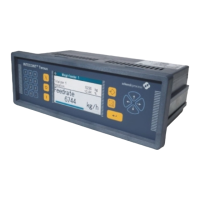
Describes the structure and elements of the INTECONT Tersus display.
Provides a quick overview of the graphic display elements and their functions.
Explains the two-stage function distributor for accessing device functions and dialogs.
Details how to switch totalizing on/off and operate the system in normal mode.
Describes how to test the display and view software version information.
Explains how to switch between keyboard and external control sources.
Details the functions related to controlling the prefeeder's impact on INTECONT.
Describes how to test system functions without material during start-up.
Explains how to access and initiate basic and subsequent calibration programs.
Details the calibration program for calculating belt circuit impulses from the speed sensor.
Describes the taring program to record zero point error of the belt weigher.
Explains the program to control system turndown using a calibration weight.
Describes how to change the date and time settings for the scale.
Explains how to view changeable characteristics and data adapted to the weighing task.
Explains how to print status reports containing configuration and event information.
Details dispatching material in preselected quantities and system switch-off upon reaching setpoint.
Explains how batch results are sent to a file or printed via web server or printer.
Covers effective weighing platform length and its importance for calibration.
Explains the use of calibration weights to control the weighing system.
Details the importance and entry of belt inclination as a parameter.
Guides on entering nominal and calibration data from technical data sheets.
Describes checks for tachometer and load cell function during startup.
Explains testing the system using calibration weights to identify faults.
Details how to check and verify belt speed measurement accuracy.
Guides on achieving accurate continuous measurement using bulk material tests.
Lists commonly used parameter-related abbreviations for clarity.
Explains how to assign event classes to parameters for system reaction to deviations.
Provides an overview and details of all system parameters, organized into blocks.
Configures operator interaction, display units, and access authorization for parameters.
Sets nominal flow rate, speed measurement, and pulses per length for calibration.
Defines parameters for belt circuit, LC characteristic value, and calibration weight.
Sets thresholds for flow rate, load, and speed, defining event triggers.
Configures time constants for measurement and display filters to smooth data.
Provides detailed descriptions of various events, categorized by group.
Lists events related to calibration errors like LC input or linearization issues.
Covers controller-related events such as batch setpoint deviations.
Lists events related to power failures and sensor errors in the electrical system.
Details events related to interlocks and source run enable signals.
Covers events related to material flow issues like out-of-tolerance batches.
Lists events indicating maximum threshold exceedances for load or flow rate.
Details events related to mechanical issues like belt slip or skew.
Lists events indicating minimum threshold undershoots for load or speed.
Covers events related to maintenance intervals and external signals.
Lists system messages concerning memory, communication, or license errors.
Provides a table categorizing event groups by identifier and their respective domains.
Lists detailed technical specifications and information on replacement parts.
Provides diagrams illustrating various connection types for the system.
Guides on the process of switching over from older INTECONT PLUS models.
Details the PROFIBUS module, its layout, and settings.
Describes the DeviceNet module, its properties, and layout.
Explains the Modbus interface card, its properties, and layout.
Describes the status and function of the system's LEDs for diagnosis.
Explains how to access the scale's homepage via a web browser and available data.
Details where to find system data like software version, hardware version, and IP address.
Provides detailed system information accessible through service tables.
Explains options for clearing fieldbus coupling and activating options.
Outlines procedures for checking tachometer and load cell functionality.
Details how to use a simple test connector for basic function control.
Describes how to start and stop the belt drive, prefeeder, and measurement.
Explains how to shift the measuring point to the discharge point using a time-lag device.
Details the built-in drift and slippage monitoring functions.
Explains how to record and correct belt impact influence for short-term accuracy.
Covers linearization procedures for non-linear components or major load fluctuations.
 General
| Brand | Schenck process |
|---|---|
| Model | Intecont Tersus Beltweigher |
| Category | Control Panel |
| Language | English |

 To Next Page
