5-2
056404-443 Operator Manual Operating Instructions
Before using the table, either in regard to operating it or performing maintenance, in addition to the above warnings
and cautions, ensure familiarity with all safety precautions and pinch point locations presented in S
ECTION 1,
S
AFETY PRECAUTIONS AND PINCH POINTS.
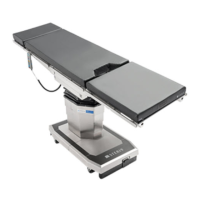
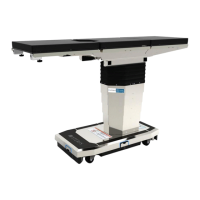
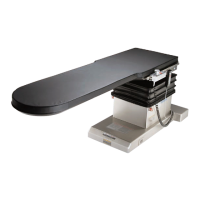
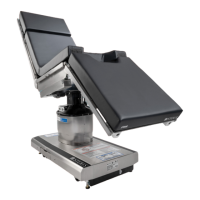
5.2 Operating the Surgical Table
1. Review Pinch Point Warnings as presented in SECTION 1.3, PINCH POINTS of this manual.
2. For instructions concerning one or more of the following tasks, refer to Section 4, Before using the Table and
perform necessary tasks, for example, installing the head rest and the leg section.
• Grounding
• Installing Battery Fuse
• Connecting Table to AC Power
• Connecting Universal Hand Control
• Connecting Optional Foot Control
• Installing/Removing Dual-Articulating Headrest
• Installing/Removing Leg Section
• Installing/Removing Table Pads
• Installing/Removing X-Ray Top
• Accessories/Side Rails
3. For information concerning charging the battery, refer to S
ECTION 6.6, BATTERY CHARGING.
4. Verify power cord is plugged into both the facility outlet and table receptacle and Main Power Switch is in ON
position.
NOTE: For cord connected tables, the power cord attachment plug is to be used as a disconnect from facility
power. The surgical table must be positioned so plug is not difficult to reach.
5. For optimum performance, before attempting to operate table, allow table to reach room temperature.
WARNING – TIPPING HAZARD:
• Do not place patient on the table unless floor locks are engaged.
• Do not use this table for patients exceeding the maximum patient weight of:
• 1100 lbs. (499 kg) Load, Normal and Reverse Patient Position; raise or lower only (no tabletop
articulation or slide).
• 1000 lbs. (454 kg) Load, Normal and Reverse Patient Position; raise or lower; includes all
tabletop articulation except tabletop slide.
• 600 lbs. (272 kg) Load, Normal Patient Position; raise or lower; includes all tabletop articulation
and full tabletop slide, (also includes Reverse patient slide toward patient feet but not patient
slide toward patient head).
• 575 lbs. (260 kg) Load, Normal and Reverse Patient; raise or lower; includes all tabletop
articulation and full tabletop slide, including reverse patient slide toward patient feet and toward
patient head.
• Center tabletop over column before applying chest compressions
• WARNING – PERSONAL INJURY HAZARD:
• Do not exceed 350 lbs. (159 kg) on the leg section.
• Dual-articulating headrest side rails support 100 ft-lbs. (135 N•m) maximum.
The headrest end rail supports 50 ft-lbs. (67 N•m) maximum.
Exceeding these limits could result in injury.




 To Next Page