23
Unit Description
Unit Overview
The Thermo King SB-210+/310+ is a one piece,
self-contained, diesel powered, air cooling/heating unit
operating under the control of a SMART REEFER 2 (SR-2)
programmable microprocessor controller. The unit mounts on
the front of the trailer with the evaporator extending through an
opening in the front wall.
The SB-210+/310+ features cooling and heating using a quiet
running engine from the Thermo King TK486 engine family.
The SB-210+ and SB-310+ are available in the following three
models:
SB-210+ 30: Cooling and heating on diesel engine
operation.
SB-210+ 50: Cooling and heating on diesel engine operation
and electric standby operation.
SB-310+ 30: High capacity cooling and heating on diesel
engine operation. Designed for engine operation at a high
speed of 2600 rpm.
The Electronic Throttling Valve (ETV) provides enhanced
control of the refrigeration system. The ETV is optional on the
SB-210+ and standard on the SB-310+. See “Electronic
Throttling Valve” on page 28.
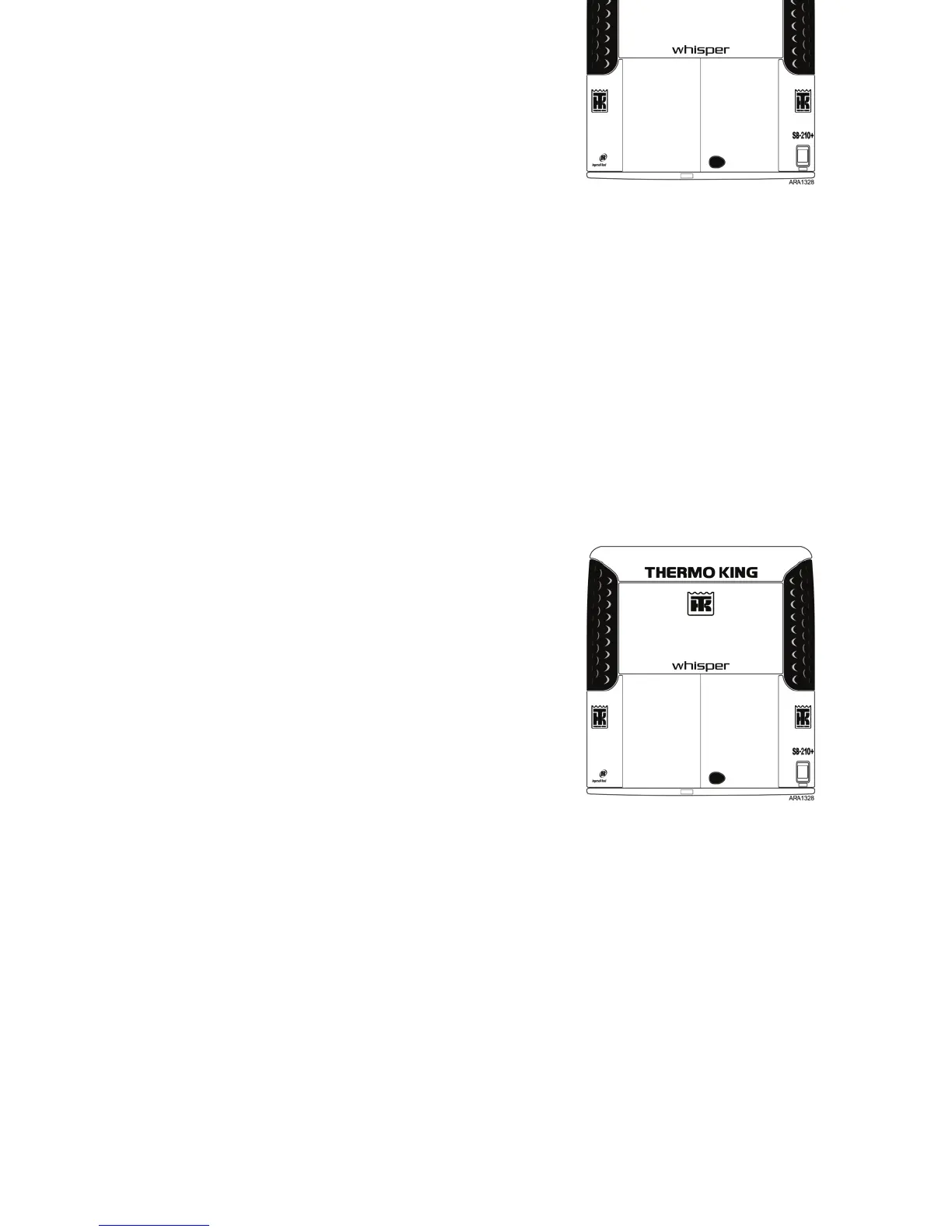
Figure 7: Front View
23
Unit Description
Unit Overview
The Thermo King SB-210+/310+ is a one piece,
self-contained, diesel powered, air cooling/heating unit
operating under the control of a SMART REEFER 2 (SR-2)
programmable microprocessor controller. The unit mounts on
the front of the trailer with the evaporator extending through an
opening in the front wall.
The SB-210+/310+ features cooling and heating using a quiet
running engine from the Thermo King TK486 engine family.
The SB-210+ and SB-310+ are available in the following three
models:
SB-210+ 30: Cooling and heating on diesel engine
operation.
SB-210+ 50: Cooling and heating on diesel engine operation
and electric standby operation.
SB-310+ 30: High capacity cooling and heating on diesel
engine operation. Designed for engine operation at a high
speed of 2600 rpm.
The Electronic Throttling Valve (ETV) provides enhanced
control of the refrigeration system. The ETV is optional on the
SB-210+ and standard on the SB-310+. See “Electronic
Throttling Valve” on page 28.
Figure 7: Front View



 To Next Page