In-line Gigabit Ethernet ports can be congured as fail-open or fail-closed. The RJ-45 monitoring ports are built-in and include an
built-in fail-open functionality as well. All other monitoring ports require the use of either Trellix's 4-port 1/10 Gigabit Modular
Passive Fail-Open kit or external active fail-open (AFO) kits for In-Line Fail-Open Active conguration.
The 8-port SFP+ module and its monitoring ports require the use of external active fail-open for fail-open functionality.
Gigabit Ethernet ports fail-close, means the ow of trac will stop if the Sensor fails. To allow trac to ow uninterrupted, you
must use special hardware, and cable the Sensor to external active fail-open kits. For instructions, see the subsequent sections of
this chapter.
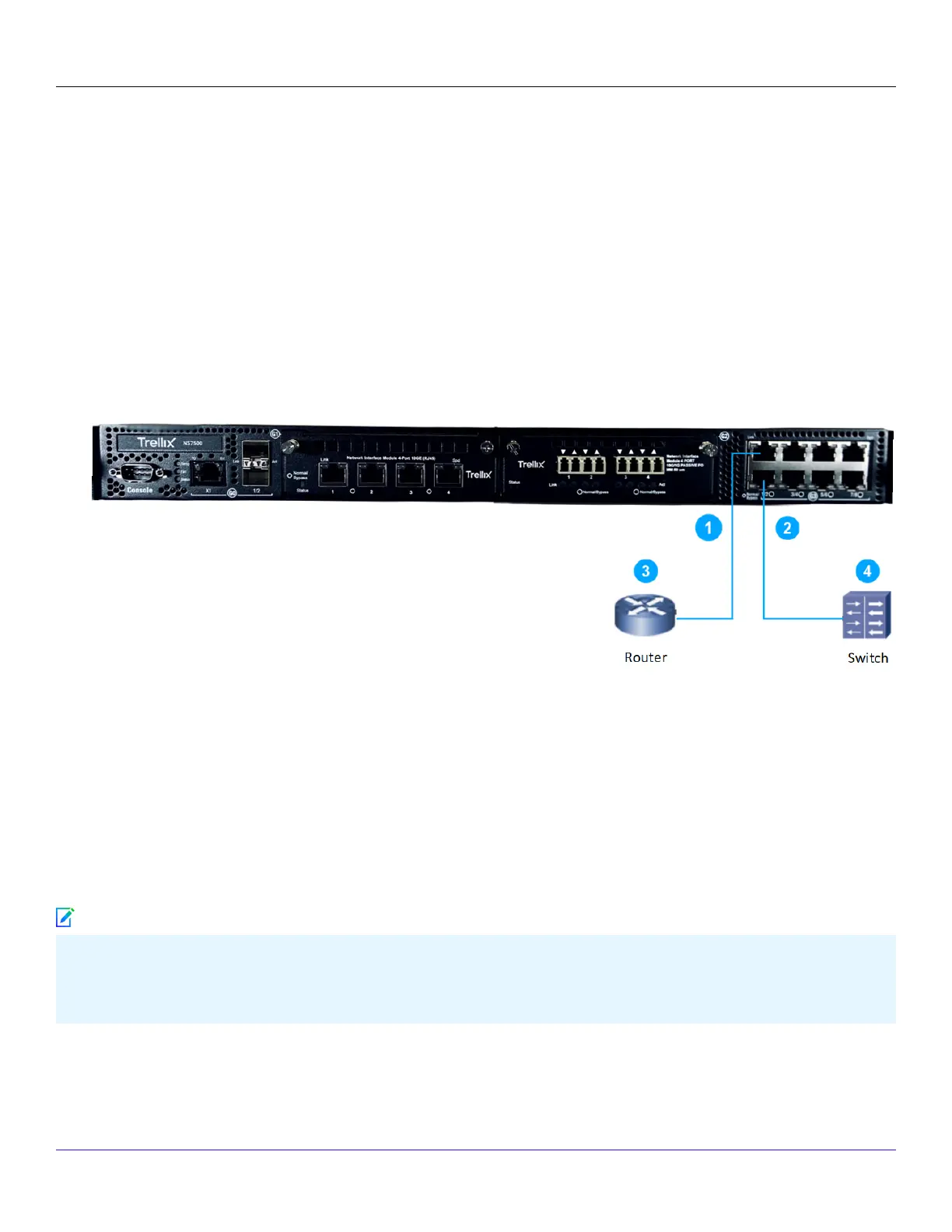
This section provides the steps to connect the Sensor's Gigabit Ethernet ports so they fail-close.
1. Plug the cable appropriate for use with your transceiver module into one of the Monitoring ports, for example G3/1.
2. Plug the cable appropriate for use with your transceiver module into one of the Monitoring ports, for example G3/2.
3. Connect the other end of each cable to the network devices that you want to monitor.For example, if you plan to monitor
trac between a switch and a router, connect the cable connected to 1 to the router (3) and the one connected to 2 to the
switch (4).
:
Connect the cables for tap mode
To deploy the Sensor in tap mode, you must use a Sensor's Gigabit Ethernet Monitoring port pair with a third-party external tap.
For a list of Trellix-approved third party vendors, see the KnowledgeBase at https://supportm.trellix.com. Enter the relevant
KnowledgeBase article in Search the Support Knowledge Center and click Search to locate the relevant KnowledgeBase
article.
Steps:
1. Plug the cable appropriate for use with your transceiver module into one of the Monitoring ports, for example, G1/1.
| NS7500 Sensor3
Trellix Intrusion Prevention System NS-series Sensor Product Guide
149
Note



 To Next Page