Learning Advanced Features
Learning Advanced Features
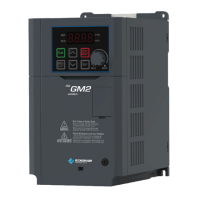
This chapter describes the advanced features of the GM2 inverter. Check the reference page in the
table to see the detailed description for each of the application features.
Auxiliary frequency
operation
Use the main and auxiliary frequencies with the predefined
formulas to create various operating conditions. Auxiliary
frequency operation is ideal for Draw Operation* as this
feature enables fine-tuning of operating speeds.
Jog operation is a kind of a manual operation. The inverter
operates to a set of parameter settings predefined for Jog
operation, while the Jog command is applied.
Control the speed of the motor using digital inputs set to Up
(increase) and Down (decrease).
3-wire operation is used to latch an input signal when using
a momentary input. This configuration is typically used to
operate the inverter by a push button.
This safety feature is used as a Run Enable input or as an
interlock to allow inverter operation only after the input is
closed. This feature is useful for safety and/or interlocking
operation with other equipment.
Use this feature for the lift-type loads such as elevators,
when the torque needs to be maintained while the brakes
are applied or released.
This feature ensures that the motor rotates at a constant
speed, by compensating for the motor slip as a load
increases.
PID control provides automatic control of the inverter’s
output frequency for automated control of flow, pressure,
and temperature.
Used to automatically measure the motor control
parameters to optimize the inverter’s control mode
performance.
Sensorless vector
control
An efficient mode to control magnetic flux and torque
without special sensors. Efficiency is achieved through the
high torque characteristics at low current when compared
with the V/F control mode.
Used during power outages to maintain the DC link voltage
for as long as possible by controlling the inverter output
frequency, thus to delay a low voltage fault.
Used to save energy by reducing the voltage supplied to
motors during low-load and no-load conditions.
Used to prevent faults when a start command is applied
while the motor is idling or free-running.
Used to automatically restart the inverter when a fault
condition is reset.


 To Next Page
 Loading...