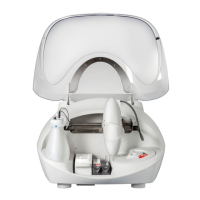
15
Both 60 mL and 20 mL bottles can be placed in the inner ring.
e rotor is refrigerated, and the mean temperature inside it is below 8degrees C. e fridge has an independent
power supply system with its own switch so that when the analyser is switched o, the fridge can continue to operate.
2.3. Reaction rotor
e reaction rotor has 120 positions and a cover. e whole assembly is refrigerated.
e rotor is a single part made of PMMA and has 120 positions. e sample and reagent mixture reactions are
performed on it. Dierent optical readings are taken during the reaction. e PMMA material lters UV radiation.
e rotor is maintained at a stable temperature of 37 degrees C by a Peltier-based thermostatting system.
e reaction volumes range is from 200 μL to 600 μL.
Each arm dispenses in a dierent position from the rotor. e dispensing positions are:
• Cycle 1: R1 dispensation
• Cycle 31: S dispensation (sample)
• Cycle 32: R1+S stirring
• Cycle 33: Initiation of photometric readings
• Cycle 66: R2 dispensation and stirring of reagent 2
• Cycle 100: End of the reading processes
• Cycles 101 –111: Elimination of the completed reaction and cleaning of the sample well in the wash station.
2.4. Optical system
e optical system is located in the reaction rotor, below the wash station.
It is formed by a set of leds, lters, beam splitters, the reaction rotor and two photodiodes.
ere is one principal reading diode and a reference photodiode that enables the correction of perturbations gener-
ated in the light source
e analyser has 8 wavelengths: 340, 405, 505, 535, 560, 600, 635, 670
e measuring range is from -0.2Abs to 3.5 Abs.
e measuring resolution is 0.0001 Abs.
e system automatically performs a blank on the cuvette before dispensing the reagent. is blank absorbance
value is used to correct the absorbance values measured in the cuvette.
If this value exceeds a preestablished limit, the cuvette is discarded.
2.5. Wash station
e wash station consists of an assembly with 7 tips located above the reaction rotor.
Each tip has a specic function and corresponds to a dierent execution cycle:
• Cycle 1: Suction of the high contamination waste and dispensing of the washing solution
• Cycle 2: Suctioning and dispensing of the washing solution
• Cycle 3: Washing solution rest phase


 To Next Page