17
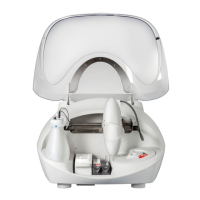
• R1 reagent arm: from 150L to 500 L
• R2 reagent arm: from 40 L to 300 L
Each arm has a tip with an automatic level detection system. e tip descends until it reaches the reagent or sample,
depending on the case, and then suctions the programmed volume. is prevents the tip from penetrating too deeply
in the uid and makes it easier to wash the tip.
Each arm has a vertical collision detection system to prevent the tips from colliding with each other and ensure
they are not damaged.
e sample dispensing arm has a clot detector. is system warns the user if the tip becomes blocked when suction-
ing the sample. e blockage may be due to traces of brin or clotting present in the serum sample.
2.9. ISE module (optional)
e ISE ion module is optional, and is used to determine Na
+
, K
+
, Cl
-
and Li
+
ions in serum and urine samples.
e ion module is fully autonomous and functions in parallel, together with the biochemical determinations.
When ISE ion testing of patients is programmed in the list, the sample-dispensing arm is responsible for positioning
the sample in the ion module.
e module has a fully sealed kit that contains the calibration standards and collects the waste. is kit is an acces-
sory and its compartment is accessible from the front part of the analyser.
2.10. Operating mode
e analyser performs the tests patient by patient and permits the continuous input of samples. e analyser is
controlled by a dedicated PC that is in permanent communication with the instrument. e application programme
installed in the computer keeps the user constantly informed about the state of the analyser and the progress of the
tests. As the results are obtained, the computer immediately displays them to the user.
When starting a Worksession, the analyser proposes the performing of the blanks, calibration standards and controls
programmed for the measuring procedures it must execute. e user can decide whether or not to execute the blanks
and calibration standards. If they are not executed, the analyser will use the latest data available. e controls can also
be activated or not activated. During a worksession, while the analyser is operating, the user can enter new routine
or urgent samples for analysis. Every time a new sample is added, the analyser automatically proposes potential new
blanks, calibration standards or controls that must be executed. It is advisable to restart the session each working day.
e analyser determines the concentrations of the analytes based on optical absorbance measurements. To measure
the concentration of an analyte in a sample, the analyser pipettes a specic volume of reagent, thermostats it in the
same tip and dispenses it into the reaction rotor.
After 5 minutes the analyser pipettes a specic sample volume and dispenses it into the same well in which the
reagent was dispensed.
During the next cycle the stirring mixes the reagent to ensure correct homogenisation and the chemical reaction
is initiated. In the bireactive modes, the reaction is initiated when the analyser dispenses a second reagent into the
same reaction well and it is mixed by a second stirrer.
e reactions may be biochemical or turbidimetric reactions. In both cases, the reaction or chain of reactions
produced generate substances that attenuate certain light wavelengths, either by absorption or by dispersion. By
comparing the luminous intensity of a certain wavelength that penetrates a well when a reaction occurs and when
there is no reaction, it is possible to determine the respective analyte concentration. is comparison is quantied
with the physical magnitude absorbance. In some cases the concentration is a direct function of the absorbance and
in others, it is a function of the change of the absorbance over time, depending on the analysis mode.


 To Next Page