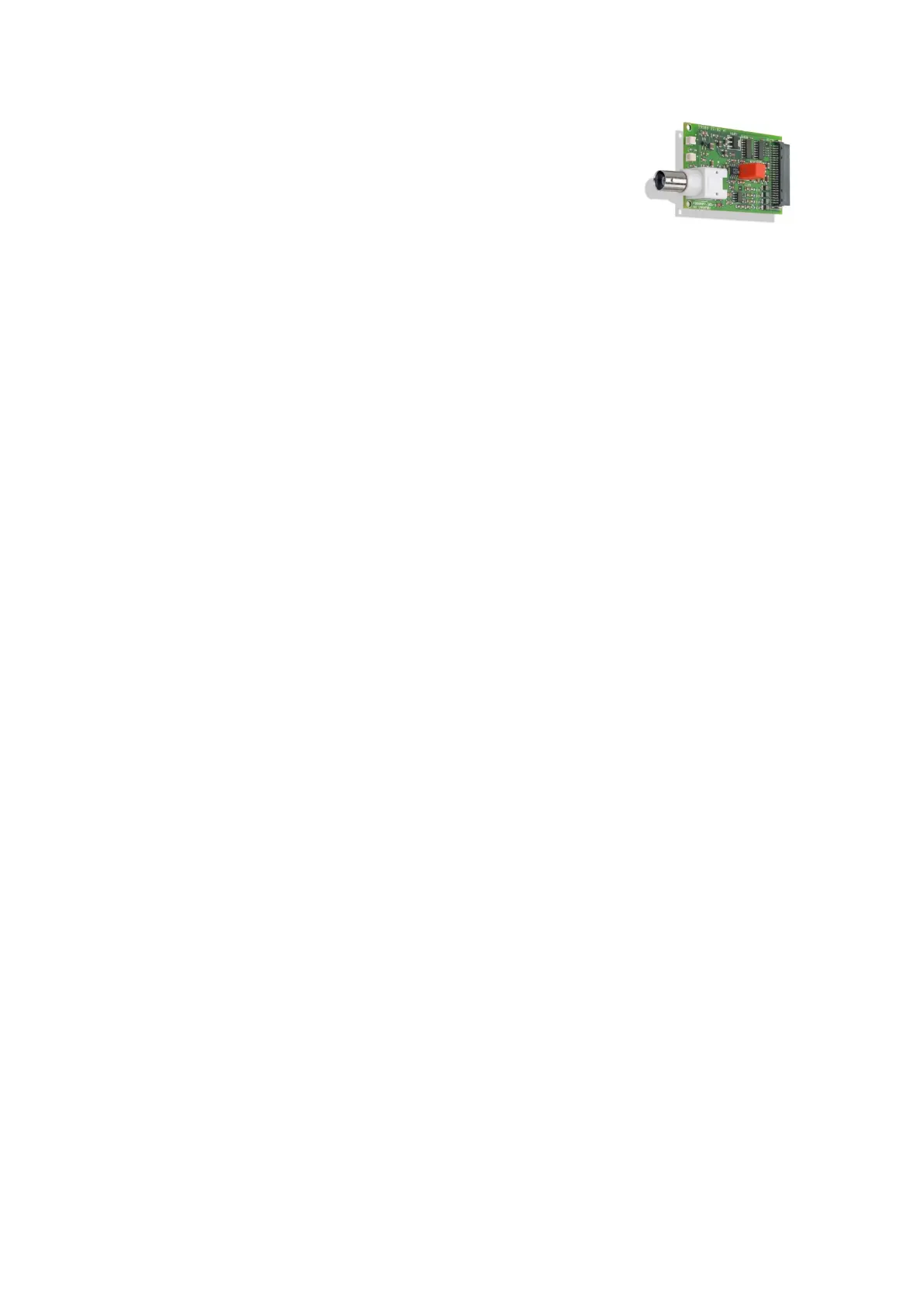
1-channel input module for displacement sensors Part B VC-6000
TM
Compact monitor
© VC-6000
TM
Compact monitor Nov, 2014 C100584.002 Module Vers. 08 - 27 -
4 1-channel input module for
displacement sensors
4.1 Function
♦ The input module for displacement sensors, abbreviated to D-TIM
(Displacement Transducer Interface Module) is laid out for connection of
a displacement sensor.
Sensors of the series SD-xxx, IN-xxx and DS-xxx from the Brüel & Kjær
Vibro delivery program can be connected.
♦ The input module is internally managed through a Sensor block
(Firmware), i.e. the D-TIM and Sensor block together form a physical
interface between the VIBROCONTROL 6000 Compact monitor
and the
outside world. The signal from the connected sensor is acquired and
made available to the signal path for further processing and evaluation.
♦ A D-TIM combines the following hardware functions:
• Differential input amplifier
• Signal amplifier
• De-coupled buffered output (front BNC socket)
for sensor output signal
• Sensor power supply
• LED signalling
4.2 Signal path
♦ The input of a D-TIM is a DC coupled differential input amplifier. The
output signal from the input amplifier is passed on to two separate signal
paths. Each signal path is assigned an A/D converter channel.
♦ DC-signal path (DC coupled processing path)
This signal path has continuous access to the entire raw signal,
including the available DC part of the signal.
In this path also the DC-operating point (sensor passive voltage)
resulting from the sensor power supply is acquired and monitored
(sensor OK-monitoring). An error-free measurement chain is
signalled through an OK LED on the front panel of the D-TIM.
♦ AC-path (AC coupled processing path)
This signal path has access only to the AC part of the raw sensor
signal. The dynamics of the processing can thus be used
completely for the vibration measurement. As a result the displace-
ment signal from a connected sensor can be evaluated with
maximum resolution and accuracy.
The input range of the AC signal path is continuously monitored for
signal over-ranging. When over-ranging of an A/D converter occurs
this is signalled by a red LED on the front of the D-TIM.


 To Next Page