Cracking
Pavement surface cracking can influence the measured deflections making it difficult to
analyze the deflection data. If cracking is turned on, the operator can record the severity of
cracks in the vicinity of the test point. This will aid the analyst in properly processing the
deflection data.
Comment
If this option is activated, the operator can enter a comment at each test point.
Reject/Accept
This option allows the operator to review, then reject or accept the measured deflections at
each test point. This option is most commonly used on structures where irregular deflection
basins are prevalent. This includes severely distressed pavements or structures with extensive
underground utilities, pipes or culverts.
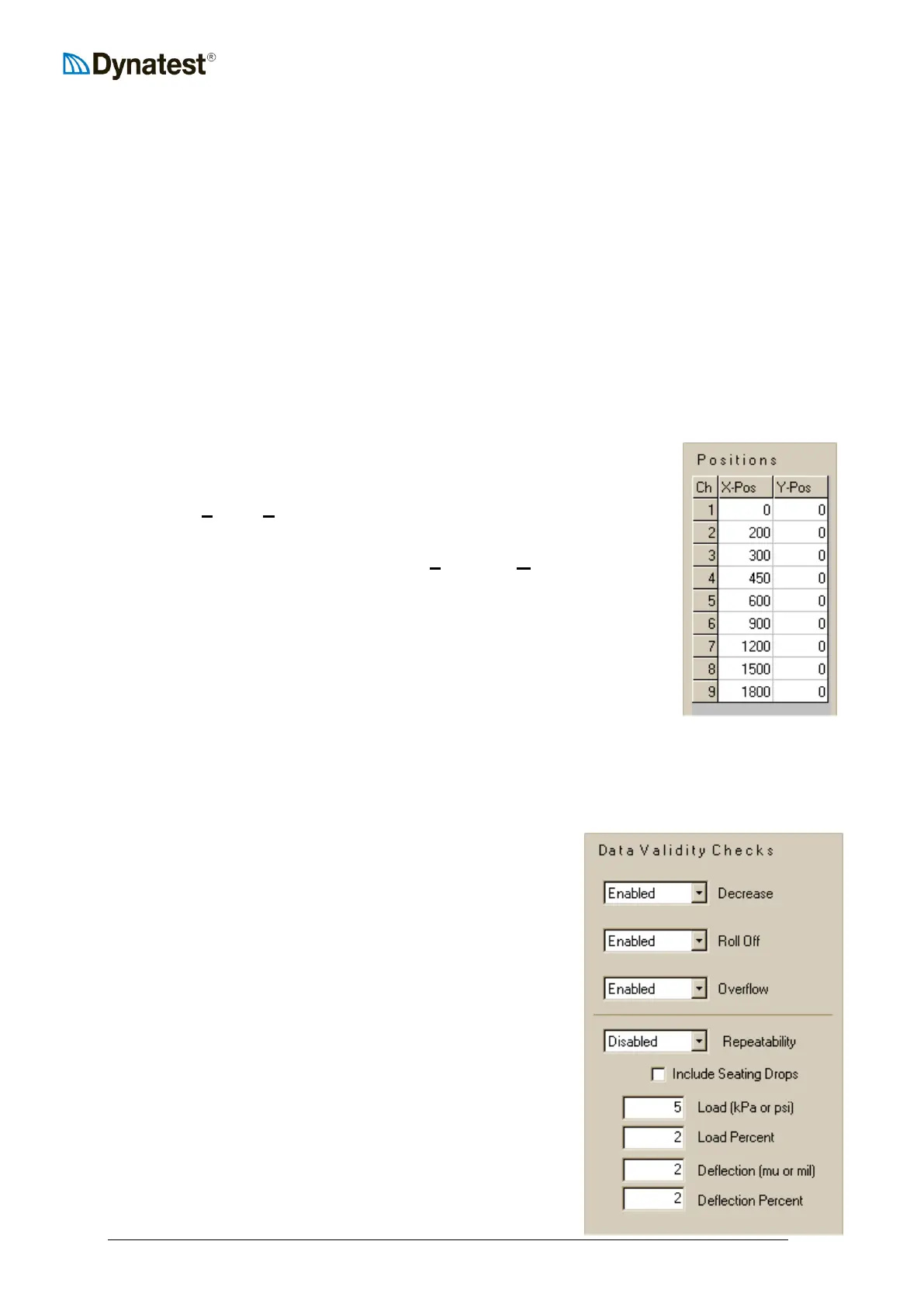
Positions
This area is used to record the positions of the deflectors. The number of
deflectors shown is determined by the number of active sensors as
indicated in UUSUUetup - UUPUUrocessor - Deflector Circuits.
Note that the deflectors are referenced by channel number. To view a list
of deflectors and assigned channels, select UUSUUetup then UUDUUeflectors from the
main menu.
Each channel is assigned an X position and a Y position. The values
displayed are a function of the display units selected, in this case
millimetres. Both the X and Y positions represent the distance from the
deflector to the centre of the load plate.
A positive X value indicates that the deflector is “in front” of the load
plate. The X axis is assumed to be parallel with the travelled lane.
The Y axis is assumed to be oriented perpendicular to the travelled lane. The meaning of a
positive Y value may differ depending on location. The local agency should establish the
convention. (If no convention, we suggest positive towards the roadway centreline).
Data Validity Checks
Data validity checks is a quality assurance feature which
alerts the operator to irregularities in the deflection data
immediately during the testing cycle. There are three simple
types of validity checks, Decrease, Roll off, and Overflow
and the more complex Repeatability.
Each type of test can be:
Disabled: The test is not performed
Enabled: If the test fails, then the test cycle will stop and
prompt the operator to decide whether to keep the data or
throw it away and repeat the test.
Relaxed: If the test fails, then the results in the data grid will
be flagged somehow but the test cycle continues.
Smart: If the test fails, then the program will automatically
repeat the last drop to obtain data that pass the test.



 To Next Page