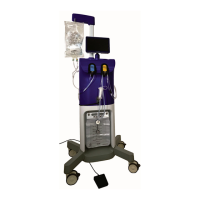
Fluent Pro Fluid Management System
2 Introduction English
1.1.9 Essential Performance
Essential Performance of the Fluent Pro Fluid Management System is to provide fluid irrigation to distend the uterus to set
pressure levels, and to provide fluid suction while monitoring fluid use to prevent unacceptable levels of intravasation.
1.2
Warnings and Precautions
1.2.1 Definitions
1.2.1.1 Warning
Warnings indicate risks to the safety of the patient or user. Failure to follow warnings may result in injury to the
patient or user.
1.2.1.2 Caution
Cautions indicate risks to the equipment. Failure to follow cautions may result in damage to the system or the
potential loss of system data.
1.2.2
List of Warnings and Precautions
The operating instructions in this guide make the system easier to use, while the recommended maintenance procedures
help to ensure optimal performance over years of reliable use. As with any surgical instrument, there are important health
and safety considerations. These are listed below and highlighted within the text. In order to meet the IEC 60601 safety
standard, the console is equipped with a potential equalization conductor which can be used to bring other equipment into
the same electrical potential as the console.
Note: The following warnings and precautions apply only to the Fluent Pro Fluid Management System. For details,
warnings, and precautions on using the hysteroscope and tissue removal device with the Fluent Pro fluid Management
system, refer to the specific documentation for the device.
1.2.2.1 List of Warnings
WARNING!
• An air embolism can be the result of air contained in the tubing or connected instrument reaching the
patient. Ensure there is always fluid in the Fluid Bag to prevent air from being pumped into the patient.
• To avoid the risk of electric shock, this equipment must only be connected to a supply mains with
protective earth.
• Do not prime inside the patient.
• The deficit is the total amount of fluid left in the patient or unaccounted for otherwise. Estimating the
fluid volume remaining in the patient is the physician’s responsibility.
• There is a risk of distension fluid reaching the circulatory system of the patient’s soft tissue by passing
through the uterus. This risk can be affected by distention pressure, flow rate, perforation of the uterine
cavity and duration of hysteroscopic surgery.
• If a low viscosity liquid distention medium is used, intrauterine instillation exceeding two (2) liters should
be followed with great care due to the possibility of fluid overload. If a high viscosity fluid (e. g. Hyskon) is
used, the use of more than 500 mL should be followed with great care. See labeling of specific fluid
used (e.g. Hyskon) for additional information.
• In rare cases, idiosyncratic reactions, including
intravascular coagulopathy and allergic reaction including
anaphylaxis may occur while performing hysteroscopy if a liquid distention medium is used. Specifically,
idiosyncratic anaphylactoid reactions have been reported when using Hyskon as a distension fluid during
hysteroscopy. These should be managed like any allergic reaction.
• Distention of the uterus may lead to a tear of the fallopian tube should there be an obstruction or
permanent occlusion. The rupture could lead to distension fluid flowing into the patient’s peritoneal
cavity, resulting in a fluid overload.
• To avoid fluid overload, closely monitor the volume of distending fluid flowing into and out of the patient
at all times. Fluid overload is associated with a risk of developing:
o Hyponatremia with its attending sequelae.
o Pulmonary edema resulting from fluid overload with isotonic fluids.
o Cerebral edema resulting from fluid overload and electrolyte disturbances with hyperosmolar
(nonionic) fluids such as glycine 1.5% and sorbitol 3.0%.





 To Next Page