Need help?
Do you have a question about the LACO Technologies TITAN Test and is the answer not in the manual?
Identifies the intended audience for these instructions.
Lists supplementary documents available on the USB drive.
Lists other relevant documents for the system.
Explains how information is presented, including warnings.
Specifies the proper application and limitations of the TitanTest leak detector.
Outlines the responsibilities and qualifications for device owners.
Details the necessary knowledge and actions for safe operation.
Identifies potential hazards associated with electric power and chemicals.
Lists the items included in the standard delivery package.
Provides important safety and handling instructions for transporting the device.
Guidelines for storing the TitanTest device under appropriate conditions.
Explains the leak detection capabilities and methods of the TitanTest device.
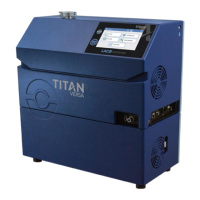
Identifies the primary components and physical layout of the device.
Describes important labels and warning stickers found on the device.
Lists detailed technical specifications for the TitanTest device.
Diagram of the vacuum system with an internal fore pump.
Diagram of the vacuum system with a dry scroll pump.
General guidelines for preparing the device for operation.
Procedure for removing a specific plug on M-Series models.
Steps for installing an external oil mist filter on P-Series units.
Information about available accessories and their compatibility.
How to connect accessories to the device's connection strip.
Procedure for connecting the sniffer line for sniff mode operation.
Information on optional remote control devices for the TitanTest.
Guidelines for connecting an exhaust line for the fore pump.
How to vent the device or connect a chamber.
Instructions for safely connecting the device to the power supply.
Step-by-step instructions for powering on and starting the TitanTest device.
Detailed operations of the device, including menu navigation.
A visual representation of the device's menu structure and navigation.
Describes the control unit, display, and function buttons of the TitanTest.
Explains common symbols used on the device's interface.
Details the layout and organization of the device's display windows and menus.
How measured leakage rates are displayed numerically or graphically.
How to navigate and interact with the setup windows and menus.
General guidance on interacting with device windows and editing values.
Describes the device's standby mode and its parameters.
How to manage venting operations from the standby window.
How to switch between different operating modes like Vacuum, Sniff, Auto Test.
Accessing settings for measurement tasks and global configurations.
How to access and initiate the calibration process.
Accessing utility functions like background cleanup.
Performing a check of the internal calibration leak functionality.
Using the background cleanup function to manage gas levels.
Adjusting display parameters like contrast, units, and language.
Setting measurement units for leakage rate and pressure.
Configuring the device's date and time settings.
Defining how measured results are displayed, including scaling and time axis.
Setting a lower limit for the leakage rate display.
Selecting the user interface language for the device.
Managing access rights for different device functions and menus.
Enabling or disabling access to maintenance functions.
Authorizing access to the device calibration functions.
Procedures for changing the device's personal identification number.
Procedures for changing the PIN required to access software menus.
Configuring the device's communication interfaces like Analog Output, RS232, RS485.
Configuring analog output settings for various parameters.
Defining where the device is controlled from (local or remote).
Configuring relay settings for different operational states.
Configuring serial port settings, including interface and protocol.
Configuring external pump setup for evacuation and measurement.
Saving and loading device parameter sets for measurement tasks.
Adjusting speaker volume and enabling/disabling beep sounds.
Configuring parameters for automated leak testing sequences.
Setting a delay before sensitive measurements to avoid fluctuations.
Defining the duration for the measurement part of the Auto Test sequence.
Setting a threshold for background gas levels before measurement starts.
Limiting the time the device waits for the background limit.
Enabling an external trigger for gas filling stations.
Selecting how the test result is determined based on leakage rate.
A table summarizing Auto Test settings.
Selecting the measurement mode and the gas being detected.
Configuring leakage rate filters and zero suppression for background noise.
Defining vacuum pressure ranges for different sensitivity levels (ULTRA, FINE, GROSS).
Setting evacuation times and configuring venting procedures.
Using background cleanup for reducing gas levels or preventing condensation.
Enabling and configuring gross leak protection to prevent contamination.
Setting pressure limits specifically for the sniff operating mode.
Defining alarm setpoints and delay times for measurement events.
Configuring parameters related to the calibration process.
Specifying whether to prompt for calibration after certain events.
Procedures for executing calibration routines for different modes.
Step-by-step guide for calibrating in vacuum mode.
How to connect and use an external calibration leak source.
The overall sequence of steps for performing a calibration.
Step-by-step guide for calibrating in sniff mode.
Performing a check of the internal calibration leak.
Detailed steps for performing measurements in vacuum mode.
Detailed steps for performing measurements in sniff mode.
How to initiate and run an automated test sequence.
How measured values are presented on the display after reaching measurement pressure.
Viewing current device settings.
Accessing detailed system data about pumps, sensors, and communication.
Viewing a graphical representation of the measurement system.
Displaying a list of the last reported errors.
Reviewing past calibration events, including dates and factors.
Using the paging function to locate wireless remote controls.
Lists warning messages, their causes, and solutions.
Lists error messages, their causes, and troubleshooting steps.
Crucial safety and handling instructions before performing maintenance.
Instructions for cleaning the exterior housing of the device.
Lists available documents and resources for further information.
Lists specific documents available for reference.
Accessing stored maintenance data and schedules.
Viewing operating hours and maintenance intervals for the device.
Configuring whether to display maintenance messages.
Performing a load test to ensure stability.
A schedule outlining maintenance tasks based on operating hours or time.
An overview diagram of the M-Series system components.
Procedure for safely removing the device cover on M-Series models.
Maintenance procedures for the backing pump in M-Series devices.
How to check the oil level in the backing pump without disassembly.
Steps to add oil to the backing pump on M-Series units.
Procedure for changing the oil in the backing pump on M-Series units.
Maintenance procedures for the oil mist filter on M-Series devices.
How to inspect, empty, and clean the oil mist filter and pan.
Procedure for replacing the filter element in the oil mist filter.
An overview diagram of the P-Series system components.
Procedure for safely removing the device cover on P-Series models.
Maintenance procedures for the backing pump in P-Series devices.
How to check the oil level in the backing pump.
Steps to add oil to the backing pump on P-Series units.
Procedures for adding or changing oil in P-Series backing pumps.
Maintenance procedures for the oil mist filter on P-Series devices.
How to inspect, empty, and clean the oil mist filter and pan.
Procedure for replacing the filter element in the oil mist filter.
Maintenance procedures for the turbo molecular pump.
Procedure for replacing the oil wick cartridge in the turbo pump.
Maintenance for the valve block component.
Instructions for cleaning the filter in the venting connection.
Maintenance related to Fan 1.
How to clean or replace the filter mat for Fan 1.
Reference to sniffer probe instructions for filter maintenance.
Procedure for replacing the ion source unit.
Step-by-step guide for replacing blown fuses.
A table listing the types and specifications of fuses used in the device.
Lists maintenance and repair kits available for the TitanTest.
Lists available accessories, consumables, and their order numbers.
Guidelines for environmentally responsible disposal of the device.
Instructions for shipping the device to LACO Technologies for service.
Details of the digital and analog input/output signals on the D-sub connector.
Information on connecting and communicating via the RS232 serial interface.
Information on connecting and communicating via the RS485 serial interface.
Details on connecting and using a remote control for the TitanTest.
Information on relay outputs for external control.
Connection details for the sniffer probe LP interface.
Overview of available serial communication protocols like LD and ASCII.
Specifies baud rate and data format for LD protocol.
Explains the structure of commands and responses in the LD protocol.
Describes the meaning of bits within the device's status word.
A comprehensive list of commands supported by the LD protocol.
Specifies baud rate and data format for ASCII protocol.
Explains the structure of commands and responses in the ASCII protocol.
Lists error messages encountered in the ASCII protocol.
Troubleshooting common problems with RS232 serial communication.
Troubleshooting specific issues related to the LD protocol.
Troubleshooting specific issues related to the ASCII protocol.
 General
| Type | Helium Leak Detector |
|---|---|
| Gas Type | Helium |
| Response Time | < 1 second |
| Power Supply | 100-240 VAC, 50/60 Hz |
| Housing Material | Stainless Steel |
| Test Method | Sniffing |
| Accuracy | ±10% |
| Output | Ethernet |
| Minimum Detectable Leak Rate | 5 x 10-12 atm-cc/sec |
| Measurement Range | 1 x 10⁻³ to 5 x 10-12 atm-cc/sec |

 To Next Page