MKS 937B Operation Manual
116
Once this procedure is complete, the I-MAG Sensor is ready for installation. If it is not to be installed
immediately, cover the flange with clean, vacuum grade aluminum foil and cap with a flange
protector.
12.2.5 Preparing the Sensor for Bakeout
To prepare the sensor for bakeout at up to 400°C, remove the sensor cable and magnet assembly as
described in "Disassembling the I-MAG sensor".
12.3 Maintenance of Low Power Nude and Mini BA hot cathode
sensors
12.3.1 Hot cathode theory
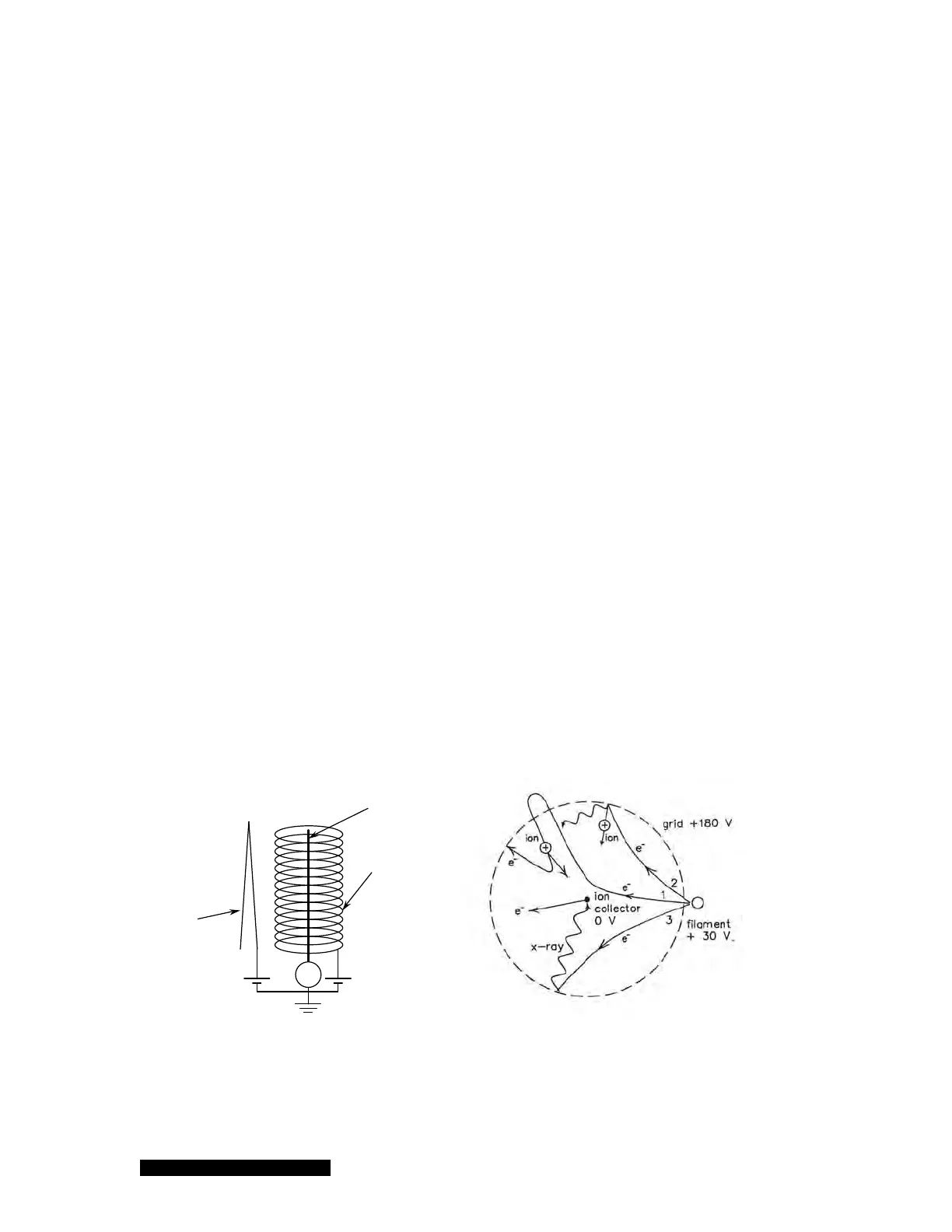
Hot cathode ionization gauges use the electrons emitted from a hot filament (thermionic electrons) to
create ions in a surrounding gas. The ion numbers are in proportion to the ambient gas pressure.
Electrons are accelerated through the gauge by a potential difference between the hot, emitting
filament and a positively charged surrounding grid (anode). The energy acquired by the electrons as
they are accelerated by the electric field in the gauge is sufficient to ionize resident ambient gas
molecules. The positively charged ions created by this collision ionization are attracted to the
negatively biased ion collector within the gauge where they are neutralized by an electron current.
The gas molecules are singly ionized and there is a one–to-one correspondence between the number
of ions neutralized and the magnitude of the neutralizing electron current. Hence the electron current
is often called the “ion current” and this is proportional to the pressure in the gauge. The “ion current”
is measured by the electrometer and converted to a pressure indication on 937B display.
The Bayard Alpert (BA) gauge is one of the most popular types of hot cathodes gauges. They are
available in glass envelopes, or mounted on a flange (the latter configuration is often referred to as a
nude gauge). The main advantage of the BA configuration is its reduced susceptibility to X-ray
induced errors. This is achieved through the adoption of a small diameter ion collector that minimizes
the area exposed to the soft X-ray emitted from the grid. X-ray emission from the grid is an
undesirable side effect of electron impact upon the grid surface since some of these X-ray strike the
ion collector, releasing electrons by the photoelectric effect. This photoelectric current is not related to
the pressure but is nevertheless added to the measurement of current determined by the
electrometer. The photoelectric current can fully mask the ion current at low pressure (around 1x10
-10
torr) and this limits the pressure measurement capabilities of the BA gauge.
Figure 12-5 BA gauge structure and electron process inside the gauge.
Ion Collector
Electron
Collector
(Grid)
Electron Source
(Filament)
A
+180V
+30V



 To Next Page