MKS 937B Operation Manual
70
8.1.2 Proper setting of a relay
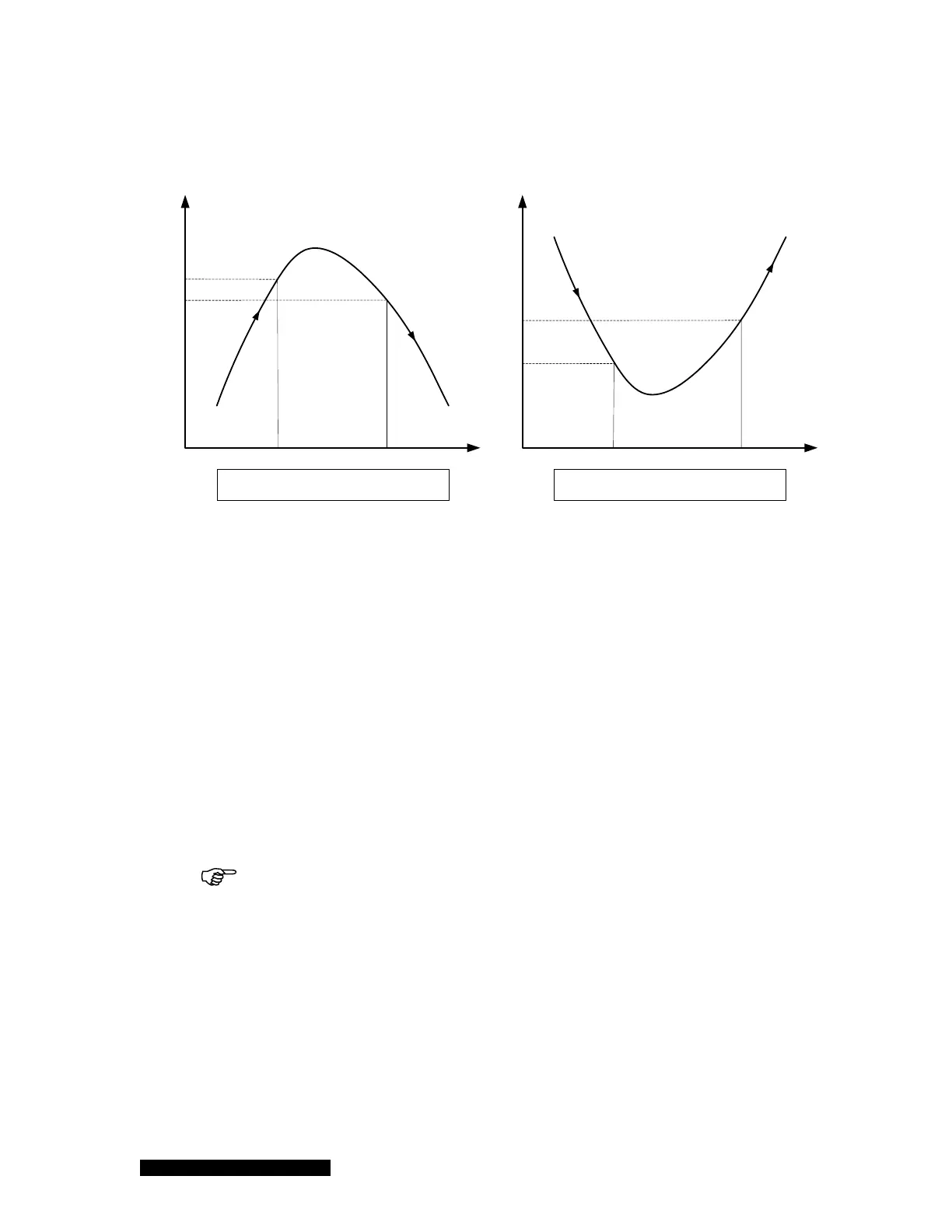
Several parameters need to be correctly set to properly use the relays in a 937B controller. Figure 8-1
shows that manner in which these parameters are defined.
Time
Pressure
Setpoint
Hysteresis
Relay
Deactivated
Relay
Deactivated
Relay
Activated
ABOVE
1. Relay is activated above the setpoint
2. Hysteresis < Setpoint
Time
Pressure
Setpoint
Hysteresis
Relay
Deactivated
Relay
Deactivated
Relay
Activated
BELOW
1. Relay is activated below the setpoint
2. Hysteresis > Setpoint
Figure 8-1 Definition of the parameters used for relay control.
1. Direction
Direction indicates the direction relative to the setpoint when the relay is activated. There are
two choices: ABOVE and BELOW.
When ABOVE is selected, the relay will be activated when the system pressure is higher than
the setpoint. All relays in the 937B are normally open so ABOVE must be selected to close a
relay when the pressure rises above a defined value. For example, the 937B can be used to
control a normally closed roughing by-pass valve in a vacuum system. If the pressure is
above certain value (defined as the roughing pressure), a relay can be activated (i.e. closed)
so that power is sup plied to the solenoid of the NC roughing valve, opening the valve.
When BELOW is selected, the relay will be activated when the system pressure is lower than
the setpoint. A typical application in this case is the control of a high vacuum chamber
isolation valve. Using relay activation in the BELOW mode, a normally closed isolation valve
can be opened only when the system pressure is below its setpoint.
Since an ion gauge (either hot or cold cathode gauge) is turned off when the
pressure is above its protection or control setpoint, only the BELOW direction is
permitted for ion gauges. It is always dangerous to assume that the pressure is above
a defined setpoint when the ion gauge is turned off.
2. Hysteresis
Hysteresis is designed to prevent chattering of the relay. System pressure may fluctuate
slightly, if the hysteresis is set too close to the setpoint value and there is a potential for
undesired relay activation.
For example, when a main high vacuum isolation valve is opened, a small pressure rise may
occur in the vacuum system. If the hysteresis is close to or identical with the pressure
setpoint, the controller will try to shut the valve. Such an operation is detrimental to system



 To Next Page