Remote Control Fundamentals
R&S
®
NRP2
174User Manual 1173.9157.02 ─ 03
5.7.2.2 Device-specific Commands
Hierarchy
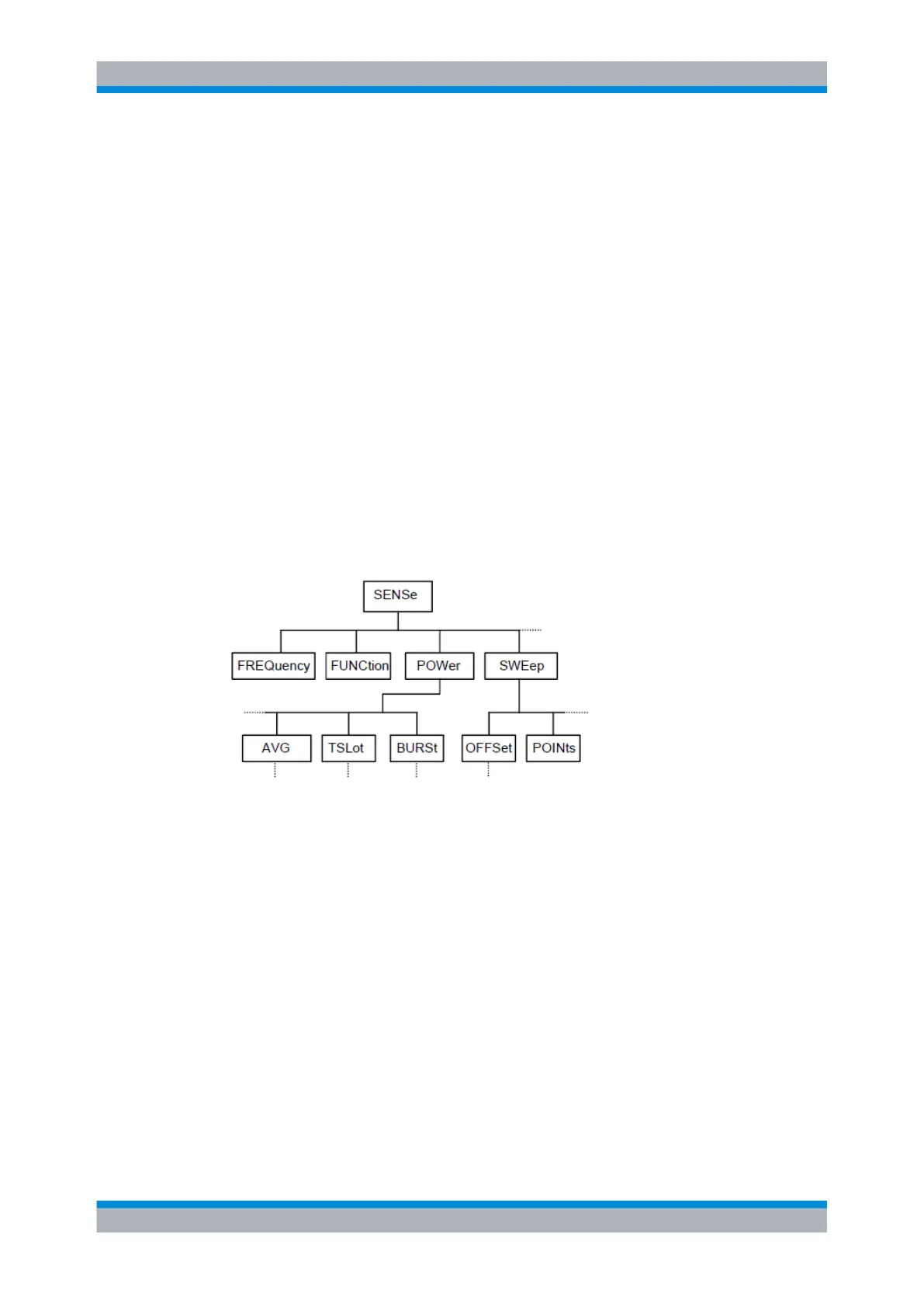
Device-specific commands have a hierarchical structure, see SCPI command tree, fig-
ure 5-1. The various levels are represented by compound headers. Headers at the high-
est level (root level) have one keyword only. This keyword describes an entire command
system.
Example:
SENSe[1..4]
This keyword denotes the command system SENSe<n>.
For lower-level commands, the full path has to be specified, starting with the highest level
in the left-most position. The individual keywords are separated by a colon ":".
Example:
SENSe[1..4]:TRACe:POINts <int_value>
This command is at the third level of he SENSe system and sets the number of test points
for the Trace mode.
Fig. 5-1: SCPI command tree
Some keywords are used at several levels within a command system. Their effect
depends on the command structure, i.e. on their position in the command header.
Example:
SENSe1:TRACe:POINts <int_value>
This command contains the POINts keyword in the third level.
SENSe1:TRACe:OFFSet:POINts <int_value>
This command contains the POINts keyword in the fourth level. It defines the time offset
for the display of points in the Trace mode.
Optional keywords
In some command systems certain keywords can be inserted into or removed from the
header. These keywords are shown in the manual in square brackets. For reasons of
Structure and Syntax of device-dependent Messages


 To Next Page