Networking
■
Networking overview ................................................. 94
■
Connect the instrument to the network ................................. 95
IMPORTANT! This document does not provide adequate detail to integrate the
QuantStudio
™
3D Instrument into all possible network architectures. Because your
laboratory network can contain advanced features (such as rewalls), we recommend
that you consult a network administrator before connecting your instrument.
Networking overview
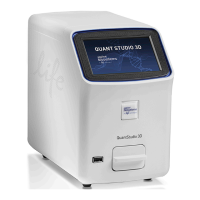
After installing the QuantStudio
™
3D Digital PCR Instrument and the
QuantStudio
™
3D AnalysisSuite
™
Software, you can connect the instrument to a local
area network to enhance its functionality. When connected to a network, the
instrument can upload data directly to the QuantStudio
™
3D AnalysisSuite
™
Software
or to a Windows
™
operating system-based or SAMBA le server, for later import by
the AnalysisSuite
™
Software.
Note: The instrument supports a wired network connection without any additional
hardware other than what is shipped with the instrument. The instrument can be
congured for wireless networking through the installation of a wireless adapter,
which is sold separately (see “Materials required” on page 96).
The QuantStudio
™
3D Digital PCR Instrument is designed to integrate into a standard
Local Area Network (LAN), both wired and wireless. The instrument features a Gigabit
Ethernet port that provides direct connection to a network via a shielded cat 6
Ethernet cable, or wireless communication via the QuantStudio
™
3D Extended Arm
WiFi Adapter.
The instrument supports the following networking technologies and standards:
•
Communication via Transmission Control Protocol (TCP) over Internet Protocol
(IPv4).
•
Internet and local host name lookups via standard Domain Name Service (DNS).
•
Local server lookups via Windows Name Service (WINS) (optional).
•
Automatic conguration of IP, DNS, and WINS settings via Dynamic Host
Conguration Protocol (DHCP), or manual conguration via the instrument
touchscreen.
D
About the
network port
and wireless
adaptor
94
QuantStudio
™
3D Digital PCR System User Guide




 To Next Page