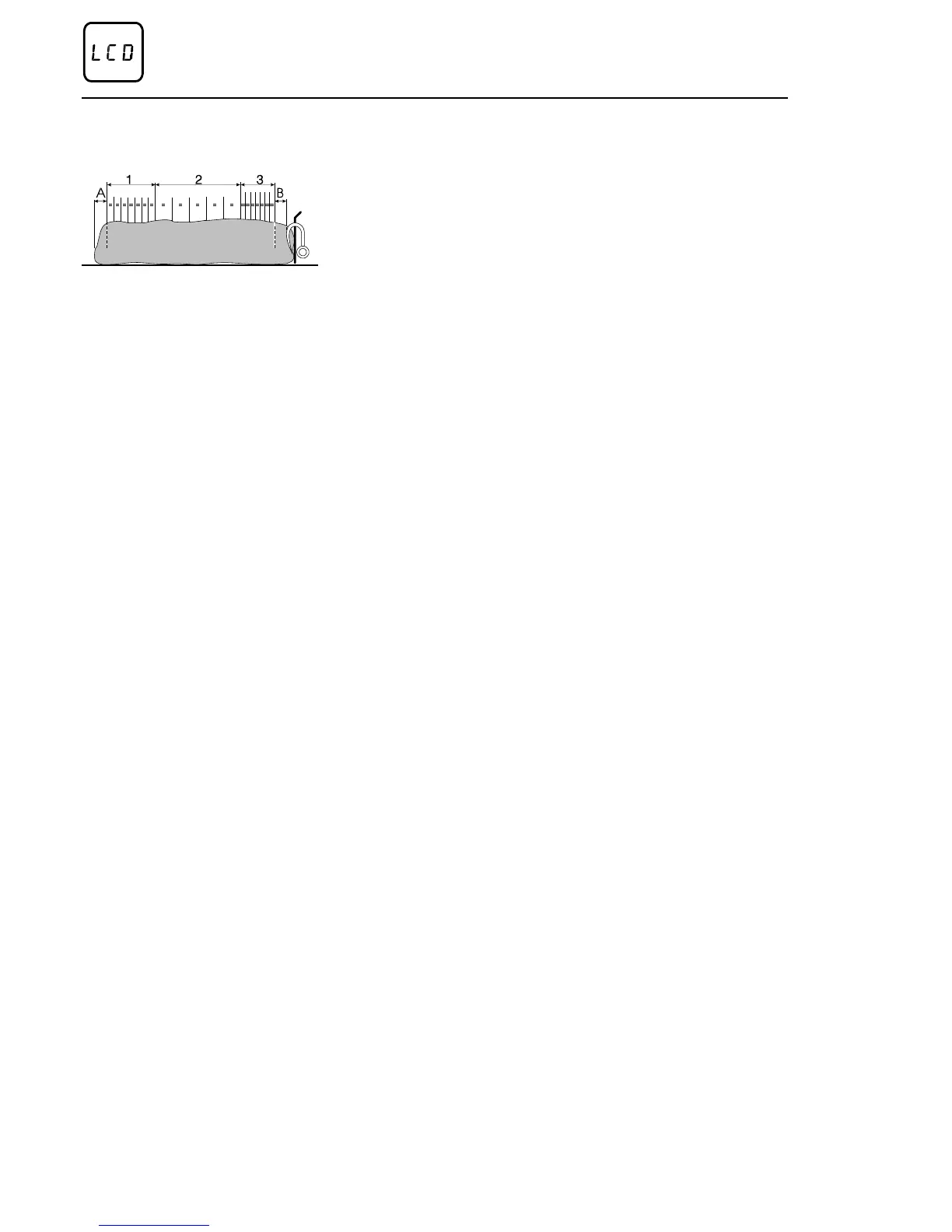
11.9. Cutting zones - definition
When a single knife is used, the product can be divided up in up to ten
different cutting zones (example: 3). The remaining centre piece between
first cut [A] and the remaining piece [B] is divided up proportionately“ in
zone lengths. These zone lengths can be set to different cutting thick-
nesses.
Alternative:
If the Number of slices type of optimisation is used, the cutting zone will
be divided up into the given number of slices.
Function after start:
– The raw material is first pushed to the knife slot.
– The control calculates the length of the product rack to be cut between
the first cut [A] entered and the remaining piece [B].
– The centre piece calculated is cut up according to the cutting thickness
set.
The thickness of the slices is increased / decreased (within the possibi-
lities of the cutting thickness tolerance set) in such a way that the last cut
corresponds exactly to the remaining piece [B] set (which can be “0 mm”
as well).
Tolerance in cutting thickness:
The tolerance in cutting thickness is used to determine by how many per
cent the slice thickness may be increased or decreased for remaining
piece processing.
Example: cutting thickness: 30 mm
tolerance in cutting thickness: 10 per cent
= the slices may vary between 27 and 33 mm in thickness.
Switching the function off:
If the tolerance in cutting thickness is set to ’0 %’, the product will be cut
as set for the cutting thickness.
The remaining piece processing function is thus switched off.
Method of operation of the control
Page 38 02/2005 123842-GB


 To Next Page