74 Vectorworks 2010 Products
Vectorworks Spotlight 2010 Getting Started Guide
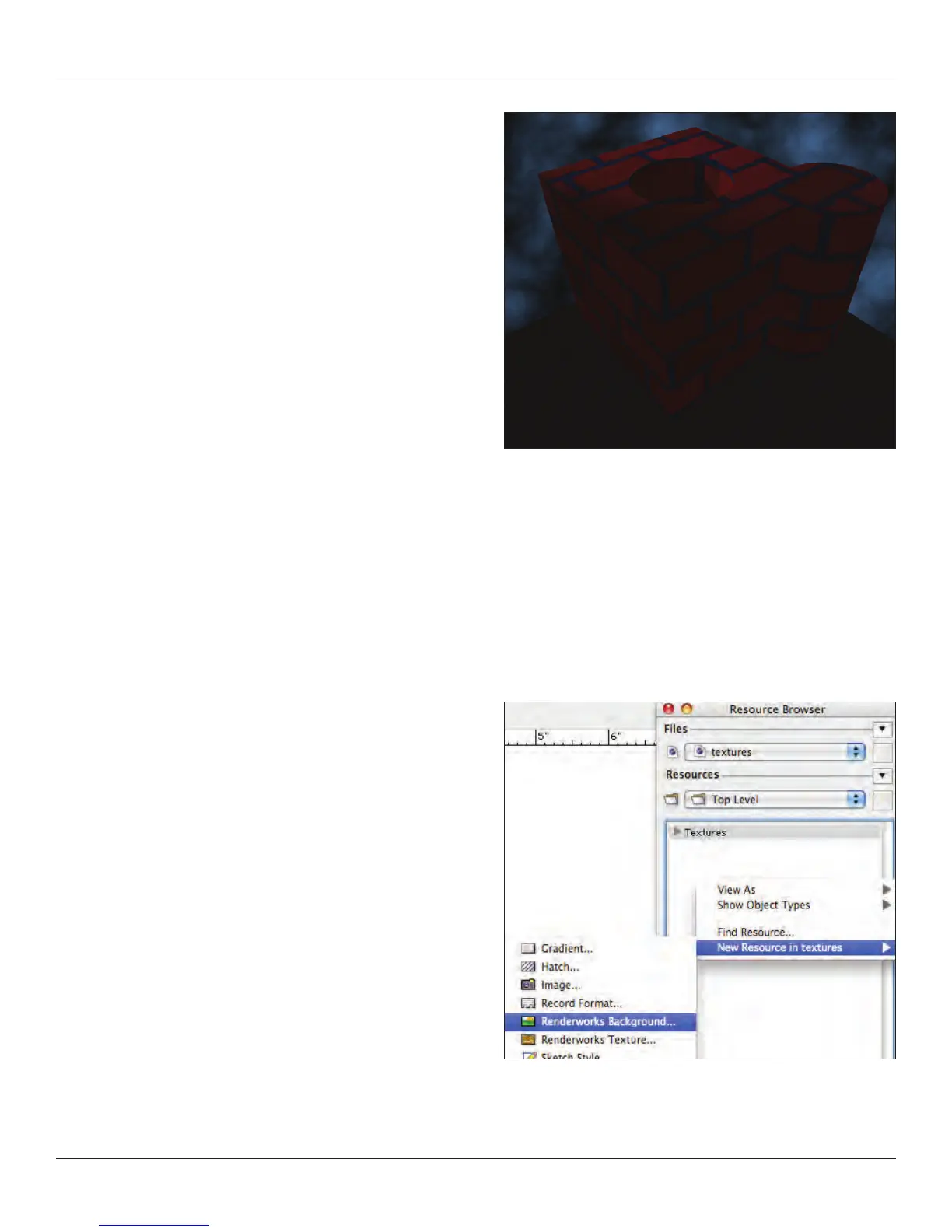
This is a sample of Final Quality Renderworks Rendering. You
will nd that with more complex models, textures and lighting that
the difference between Fast and Final becomes pretty dramatic.
Generally Fast is used for your own pre-visualization and Final
for presentations.
Open GL and Renderworks each place an unseen light source in
your renderings if you have not already ‘lit’ the scene. Since we
will deal with lighting specics next, just work with that source for
the moment.
Radiosity Renderings are absolutely lovely, but they are time and
processor intensive. I mention them here to make you aware of this
option as an advanced concept, but not one for Getting Started.
Layer Backgrounds
In our theatre space, we do no need a background, we have the architecture. However, if illustrating an isolated element or a trade
show space or many other things, you might not like to have to create a world before you render a simple object. Or you might just not
like the basic white background that is the Renderworks Default.
Let’s work in the le you created when you made the 10 3D objects.
Choose to edit your design layer via either the Navigation Palette or the Organization Dialogue. Using your existing le, you have now
the opportunity to create 10 different backgrounds. First note that in the Edit Design Layer Dialogue you can assign a background from
the default backgrounds le. Once we create a few backgrounds, you can also assign a background to a layer by double clicking on the
background icon in the Resource Browser.
So, let’s make a few backgrounds. Exit out of any
dialogues and go to the Resource Browser, right click and
select New Resource>New Renderworks Background.
Let’s take a look at your options here. Obviously, you can
name your background something that will readily remind
you of the content. There are also weather options, which
we will avoid right now as they add considerably to the
rendering time. For the moment, be aware of the options
and plan to go back and test them. Your test le is a good
place for this kind of experimentation as you have minimal
geometry to slow the process.



 To Next Page