ArcLight Hub User’s Guide
General System Description
Rev. 001 1081006 1-3
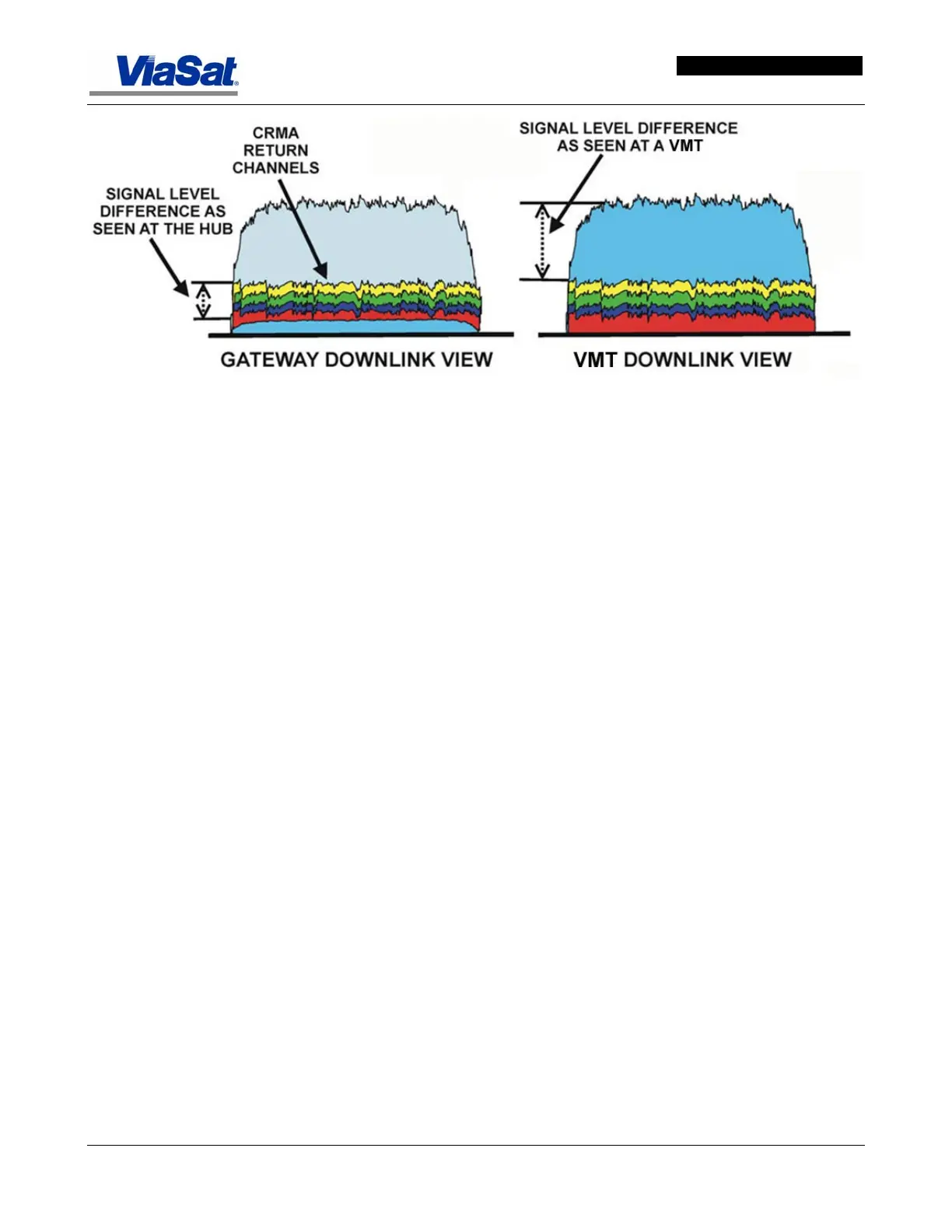
Figure 1-2. A-PCMA Level Diagram.
The situation at the Hub is reversed. The desired low-power CRMA
signal is now buried in the high power ArcLight Hub forward link
transmit signal. Recovery of the desired signal requires special digital
processing to improve the S/N ratio of the desired CRMA signal at the
Hub by removing the high-power signal. The processing is similar to
that done in voice circuits for control of voice frequency echo, called
echo cancellation. The transmitted high-power signal at the hub is
delayed and passed through a processor that models the impairments
encountered in the uplink propagation path, the satellite, and the
downlink propagation path. This processing produces an estimate of
the transmitted high-power signal, as modified by the estimated round
trip impairments, without the desired CRMA signal. This estimate is
then subtracted from the composite received signal (forward link +
CRMA) to yield the desired VMT CRMA signal with sufficient S/N ratio
to permit successful Demodulation.
Code Reuse Multiple-Access
The CRMA technique, used for the return channel from the VMT to the
Hub, is a direct sequence spread-spectrum technique similar to
conventional code division multiple-access (CDMA) used in cellular
telephony.
The benefits of using CRMA include:
• Maximum detection efficiency in random access channels. –
The use of a single spreading code word permits use of a
single correlator to feed multiple Demodulators thus reducing
equipment costs at the Hub.
• CRMA does not require stringent time and frequency
synchronization specifications. High-stability remote terminal
local oscillators and expensive fast frequency hopping
synthesizers as required in Multi-frequency Time Division
Multiple-access (MF-TDMA) architectures are not needed.
• Smaller antennas may be used at the VMTs – use of spread
spectrum reduces the energy density of the transmitted
signal and avoids adjacent satellite interference problems
solved by using a larger antenna to reduce beam width.


 To Next Page