ArcLight Hub User’s Guide
General System Description
Rev. 001 1081006 1-13
Table 1-3. Data Segment Length.
Packet Type Number of bits Symbols after FEC Flush Symbols Total Symbols
A 424 1272 12 1284
B 848 2544 12 2556
C 1696 5088 12 5100
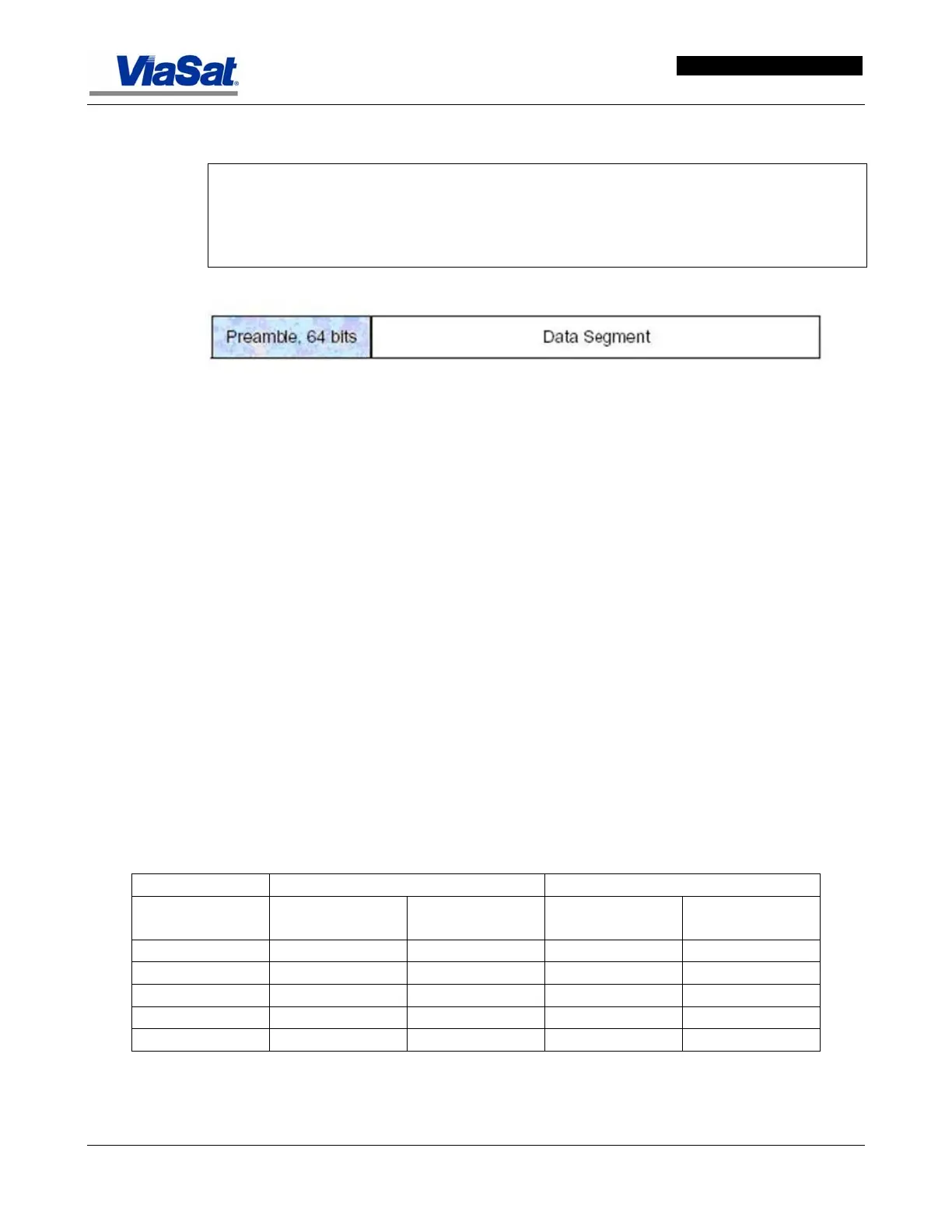
Figure 1-8. Packet Format.
The ArcLight return-channel can be configured to meet the
requirements of practically all size networks. The waveform chipping
rate, which sets the bandwidth over which the CRMA transmissions are
spread, is selectable from a very modest 384 kilo-chips per second
(kcps) to a maximum of approximately 36 Mcps.
Megachips per second (Mcps) is a measure of the speed with which
encoding elements, called chips (not to be confused with microchips),
are generated in Direct Sequence Spread Spectrum (DSSS) signals. This
speed is also known as the chipping rate. A speed of 1 Mcps is
equivalent to 1,000,000, or 10
6
, chips per second.
This is unspread mode. Spread mode operates up to 5 Mbps and
unspread mode operates up to 10 Mbps.
Typical chipping rates in third-generation (3G) wireless systems are on
the order of several million chips per second. For example, in Wideband
Code-Division Multiple Access (W-CDMA) systems, the standard rate is
3.84 Mcps.
The chipping rate is selectable within a range that is a function of the
transmitted information rate as shown in
Table 1-4. An even number of
chips per channel symbol is employed ranging from 4 to 150 in
increments of 2.
Table 1-4. Chipping Rate Ranges.
Chipping Rate Bandwidth Occupied
Information
Rate
Minimum Maximum Minimum Maximum
32 kbps 0.384 MHz 14.4 MHz 0.442 MHz 16.56 MHz
64 kbps 0.768 MHz 28.8 MHz 0.883 MHz 33.12 MHz
128 kbps 1.536 MHz 36 MHz 1.766 MHz 41.4 MHz
256 kbps 3.072 MHz 36 MHz 3.533 MHz 41.4 MHz
512 kbps 6.144 MHz 36 MHz 7.066 MHz 41.4 MHz
The Return Channel waveform employs an even number of chips per
channel symbol.



 To Next Page