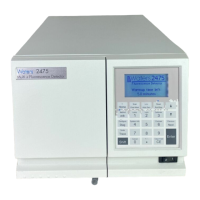
1-8 Theory of Operation
design features increase the optical throughput and sensitivity, resulting in
an overall increase in the signal-to-noise ratio:
• Standalone programmability – Stores up to 10 user-defined programs (or
methods), each consisting of up to 48 programmable, timed events and 2
programmable switches.
• Single or multichannel mode – Monitors fluorescence at one or more
discrete wavelength pairs.
• Integral erbium calibration reference – Ensures wavelength accuracy.
• Automatic second-order filter – Automatically engaged for wavelengths
of 400 nm and greater and removed for wavelengths of 399 nm or less.
• Spectrum scan and storage display – Supports spectrum scan, display,
and subtraction in addition to standard tunable fluorescence
functionality.
• Full diagnostic capability – Supports built-in diagnostic tools to optimize
functionality and performance.
• Data communications and control – By an Empower™ system or
Millennium®
32
chromatography workstation (version 3.2 or 4.0).
• Backward compatibility – Operates as a 474 Detector with an Empower
system or Millennium
32
chromatography workstation version, 3.2 or 4.0,
using RS-232, serial communication.
• Two programmable contact closure outputs – Has two configurable
switches, each of which can accommodate a maximum of +30 V and 1 A.
The switches (SW1 and SW2) can trigger fraction collectors and other
external devices. Time and fluorescence can actuate the switches.
• Normalized emission units – Enhances unit to unit reproducibility.
• Idle mode – Closes a shutter to prevent degradation of the optics.
• Fast Scan mode – Dynamically scans either the emission or excitation
grating through a selectable wavelength range to monitor the
fluorescence of a series of wavelengths. (This feature is available only in
Empower systems through remote Ethernet interface with 2475 ICS
software control.)


 To Next Page