Startup diagnostic tests 1-21
The gain for Region 2 is determined by the maximum signal level in Region 1.
Therefore, a gain of only 10 would be used from time 0.0 to time 2.0, but the
small peak may not be adequately resolved at this setting. If the detector did
find it, the peak area integration would be far less accurate because of higher
baseline noise. Failure to program a gain change at a strategic point in the
chromatogram constitutes a relatively ineffective approach to method
development.
Startup diagnostic tests
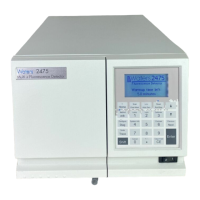
The detector runs a series of startup diagnostic tests and posts an error
message if any test fails. The startup diagnostic tests are as follows:
• Central processing unit (CPU) test
• Serial communication interface (SCI) test
• Electrically erasable programmable read-only memory (EEPROM) test
• RAM test
• Application program checksum verification
•Lamp test
•Photodiode test
•PMT test
• Optics test/Wavelength verification
Mobile-phase solvent degassing
Mobile-phase difficulties account for at least 70% of all liquid chromatographic
problems. Using degassed solvents is important, especially at excitation
wavelengths shorter than 220 nm. Bubbles in the flow cell adversely affect
detector performance. Degassing provides
• reproducible fluorescent response.
• stable baselines and enhanced sensitivity.
• reproducible retention times for eluting peaks.
• reproducible injection volumes for quantitation.
• stable pump operation.


 To Next Page