1-12 Theory of Operation
The excitation energy is focused on a geometrically matched mirror whose
shape is opposite that of the excitation energy entrance lens. Excitation
energy is reflected along the flow cell axis and back, effectively doubling the
pathlength of the cell. The increased pathlength in turn provides superior
sensitivity compared to traditional fluorescence detectors.
Photomultiplier (PMT) calibration
The sensitivity of the detector is controlled by the gain setting, which
increases the voltage to the PMT to amplify and increase response. The gain is
achieved by controlling the high-voltage supply to the PMT. After the
assembly and alignment of the detector and whenever the PMT or any PC
boards are replaced, Waters personnel calibrate PMTs using an onboard
service diagnostic function.
PMT sensitivity
After calibrating the PMT, you must choose a gain setting for the
photomultiplier tube prior to a chromatographic injection. Saturation, which
occurs when the sample concentration is high, or the experimental mobile
phase has a high background, is always a concern—even when the PMT gain
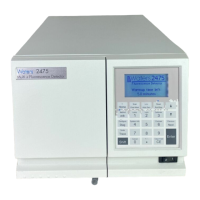
setting is at the lowest level. For this reason, the 2475 detector’s Auto
Optimize Gain diagnostic function lets you adjust the granularity of the gain.
Filtering noise
The detector uses a digital filter to minimize noise.
Lower-time constant settings produce these effects:
• Narrow peaks appear with minimal peak distortion and time delay.
• Very small peaks become harder to discriminate from baseline noise.
• Less baseline noise is removed.
Higher time constant settings produce these effects:
• Greatly decreased baseline noise
• Shortened and broadened peaks
The software includes fast, normal, or slow filtering constants at each data
rate that are appropriate for high-speed or high-sensitivity applications,
respectively.


 To Next Page