Principles of operation 1-11
and increases the detectability of low-level signals. Keeping the optics simple
tends to minimize loss of signal and maximize throughput.
Light source
The detector uses a high-intensity 150-watt xenon arc lamp as its source. The
emitted light passes through the excitation monochromator to flood the
aperture of the flow cell. The lamp light is collected by an elliptical mirror
behind the lamp, its center of curvature oriented toward the lamp’s bright
spot.
Excitation monochromator
The detector uses a monochromator to select the appropriate excitation
wavelengths defined by its geometry. The grating can rotate quickly,
responding to multiple excitation wavelengths and/or scanning.
Emission monochromator
The light emitted by the sample travels from the top of the flow cell into the
emission optics. The emission optics are positioned at right angles to the
excitation source to minimize the possibility of stray light reaching the PMT.
The emission monochromator selects the appropriate emission wavelengths.
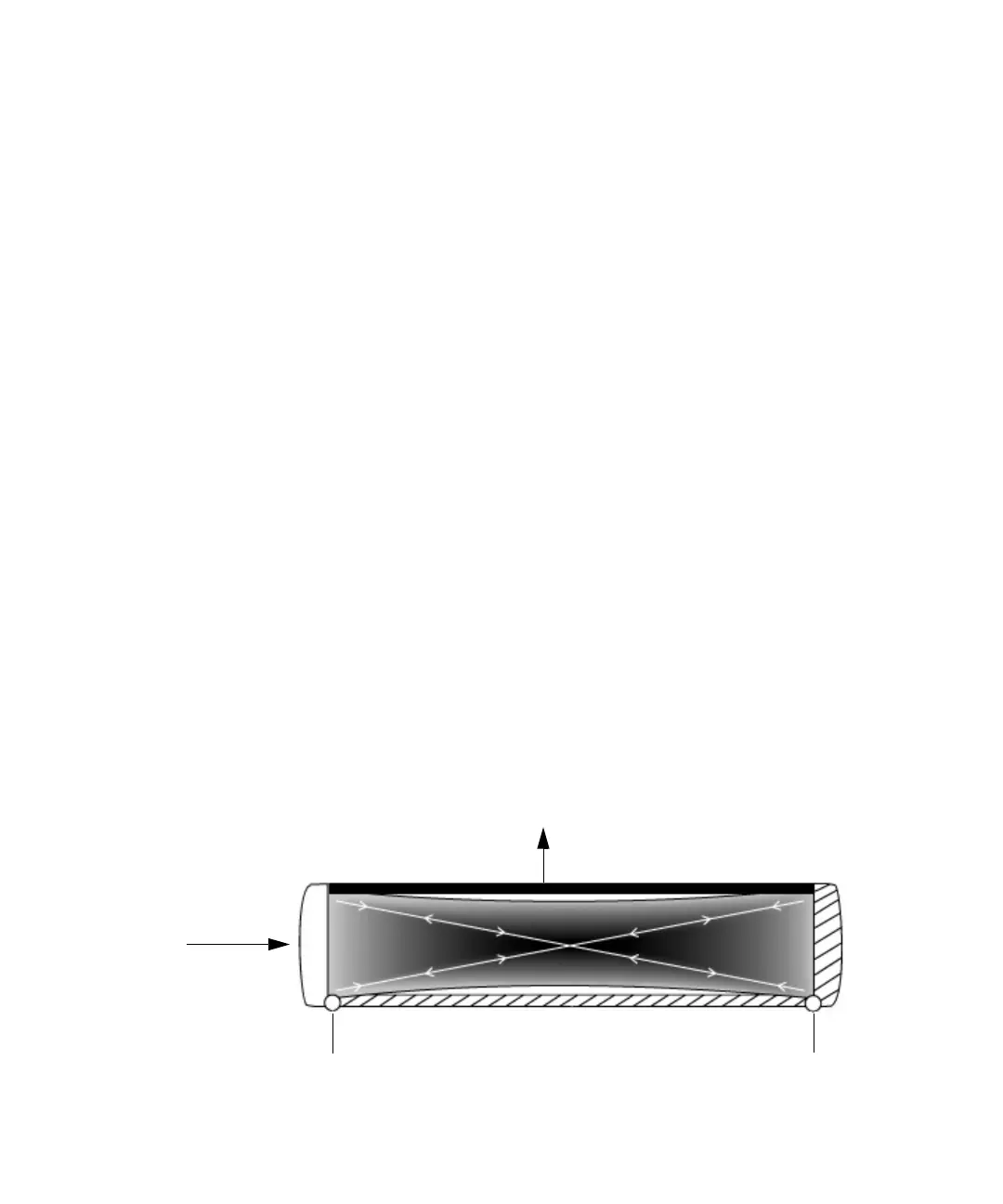
Axially illuminated flow cell
The flow cell design incorporates an axially illuminated, fused-quartz flow
cell.
Axially illuminated flow cell
Emission
energy
Quartz window
Mirror
Fluid out
Mirror
Fluid in
Lens
Excitation
energy


 To Next Page