Description
28.03.2022 33 / 112
4.5 Procedure of a tightness test
A test may consist of several tests
If a test is performed with multiple tests, the following procedure is
repeated.
Determining the initial value
After starting the test, the sensor head is moved into position and the
starting value of the deformation is set to zero.
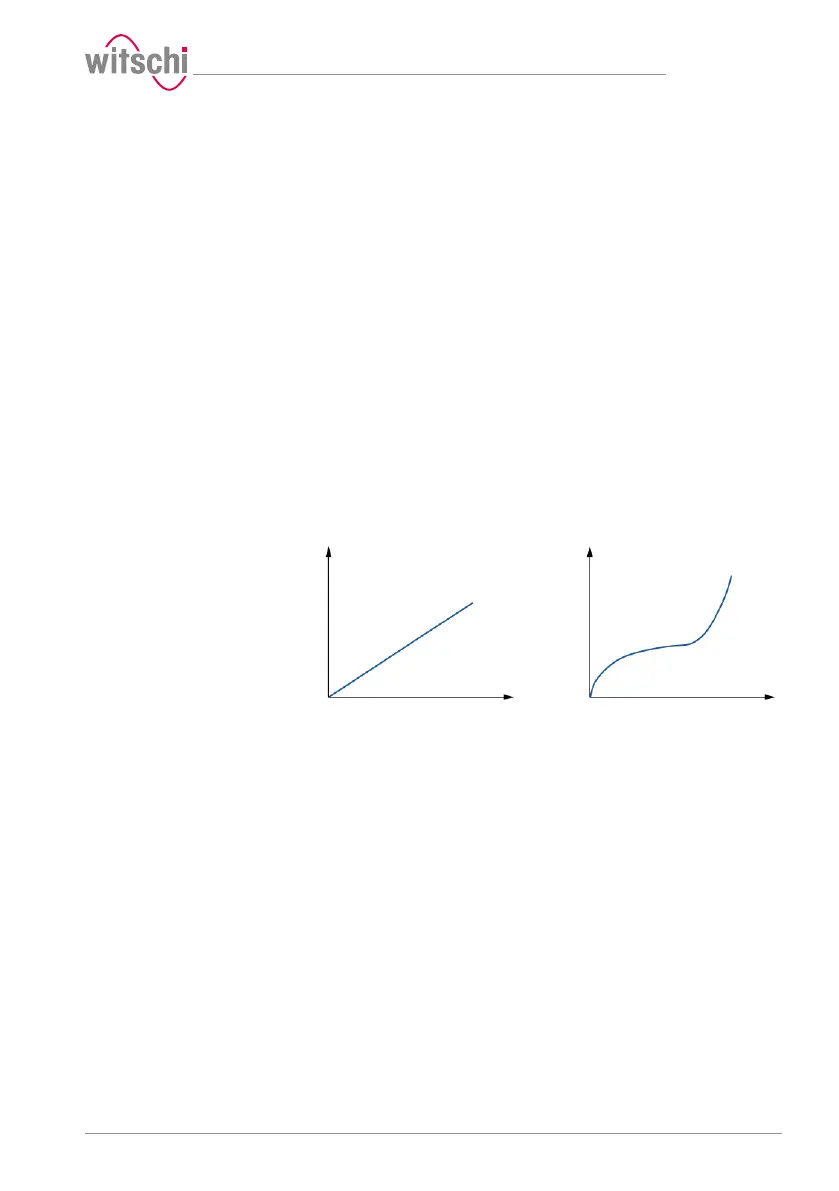
Build up pressure and record the deformation behaviour of
the watch housing
The test pressure is built up in the test chamber. In order to compensate
for pressure losses caused by the heating of the air, the test pressure is
continuously regulated during the measurement.
The deformation behaviour of the watch is continuously recorded
during pressure build-up and automatically included in the evaluation
algorithm.
Deformation Deformation
Test pressure Test pressure
Linear deformation behaviour Non-linear deformation
behaviour
Automatic measuring time
The ProofMaster has a new evaluation algorithm which detects elastic
deformation of watches and automatically compensates them.
In the standard setting, the ProofMaster automatically determines the
required measuring time for each measurement. The software continues
the measurement until a meaningful result is obtained.
The measurement time for a simple OK/not OK statement is shorter
than the output of a precise leak rate. It should also be noted that
smaller limits lead to longer measurement times. The maximum time per
test pressure is limited to 300 seconds with automatic measuring time.
For best results in terms of precision and test duration, we recommend
the use of the automatic measurement time.


 To Next Page