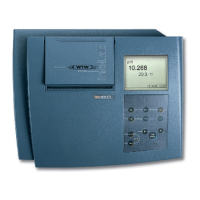
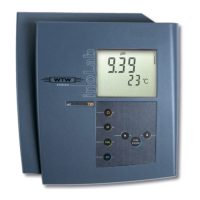
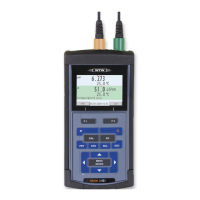
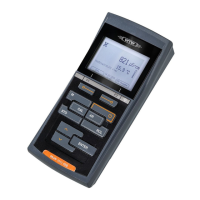
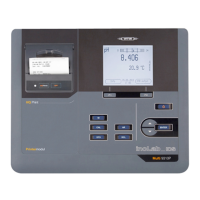
Turbidity measurement (VisoTurb
®
900-P) inoLab
®
Multi 9620 IDS
86 ba77173e04 12/2017
10 Turbidity measurement (VisoTurb
®
900-P)
10.1 Measuring
10.1.1 Measuring the turbidity
Preparatory activi-
ties
Perform the following preparatory activities when you want to measure:
Avoid gas bubbles (e.g. air bubbles) in the test sample.
Use suitable vessels for measurement and calibration
(see operating manual of the VisoTurb
®
900-P sensor).
Heed the minimum depth of immersion for the sensor
Measuring You can carry out turbidity measurements as follows:
The sensor connection and the USB-B (USB Device) interface are
galvanically insulated. This facilitates interference-free measure-
ments also in the following cases:
Measurement in grounded test samples
Measurement with several sensors connected to one
Multi 9620 IDS in one test sample
1. Connect a turbidity sensor to the measuring instrument.
The turbidity measuring screen is displayed.
The data for the connected IDS turbidity sensor are automatically taken
over.
2. Fill the test sample into a lightproof measuring beaker up to a level of
at least 6 cm.
3. When immersing the sensor in the test sample, hold the sensor at an
angle.
4. For measuring, position the sensor upright.
5. Position the sensor in a way that meets the following requirements.
Distance to the bottom: 6 cm
Distance to the walls of the beaker: 2 cm
Minimum depth of immersion: 2 cm
To position the sensor optimally and permanently while it is mea-
suring, fix it on a support.
1. Perform the preparatory activities.
2. Immerse the sensor in the test sample at an angle and then position it
in the measuring container.


 To Next Page
 Loading...