3-14
CELL-DYN
®
3200 System Operator’s Manual
9140181H—October 2001
Principles of Operation
Flow Cytometry
Section 3
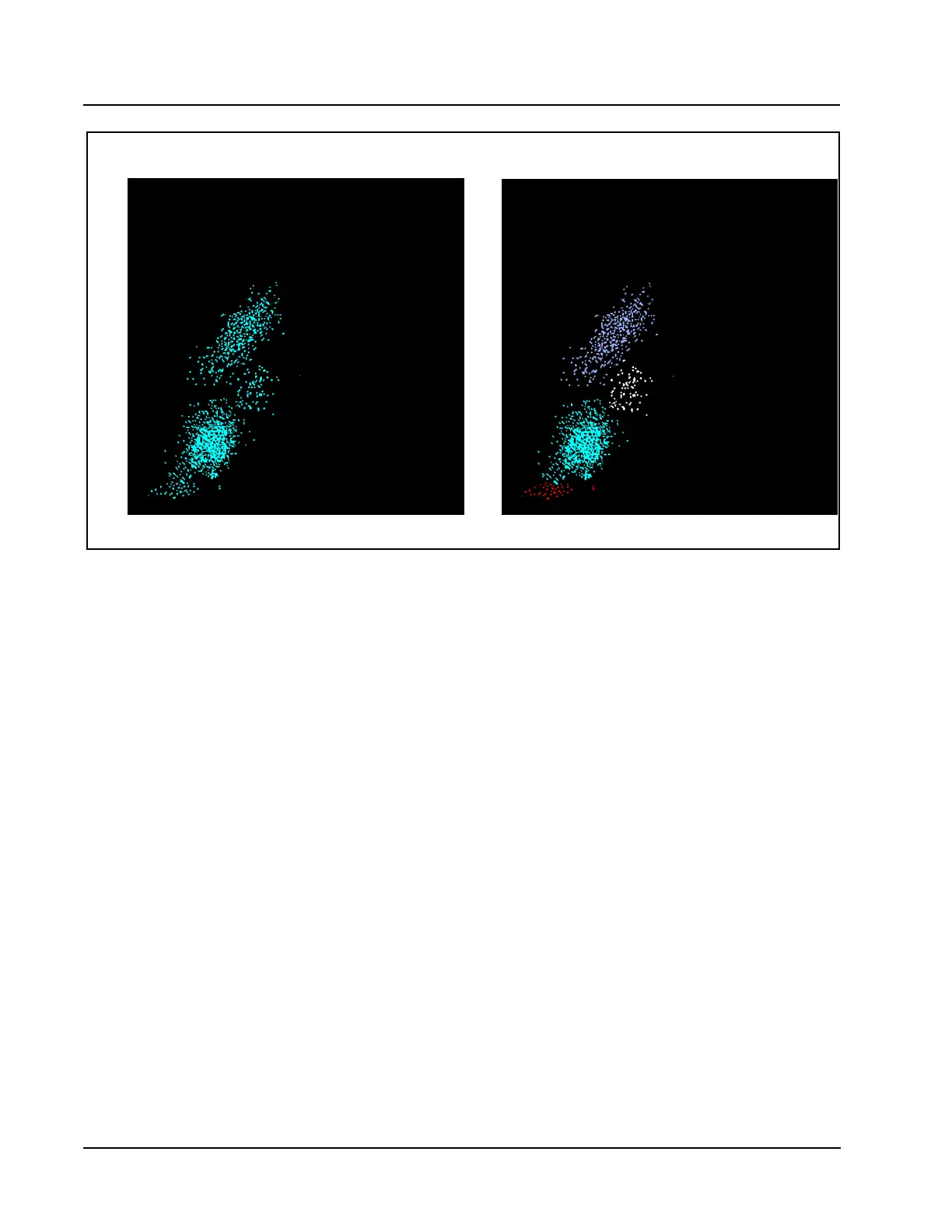
Figure 3.6 Mononuclear Scatter
Mononuclear Separation
The scatter information is plotted with the 0° scatter on the Y axis and the 10°
scatter on the X axis. (The 0°/10° scatterplot is shown in Figure 3.6.) The
mononuclear cells are plotted on this scatterplot. The algorithm also uses the
orientation of the neutrophil cluster to aid in classifying the mononuclears. Three
populations of mononuclear cells are clearly seen on the display.
There are three populations of mononuclears because basophils are included in the
mononuclear cluster. Typically, basophils are granulated cells and therefore more
complex than the mononuclear cells. However, the basophilic granules are water
soluble and dissolve in the WBC Lyse reagent. Consequently, the degranulated
Basophils becomes a less complex cell that falls into the mononuclear cluster.
The lymphocytes fall in the lowest large cluster. (The small population of cells
below the lymphocytes contains particles that are unlikely to be WBCs.) The
basophils fall in the cluster above and slightly to the right of the lymphocytes. The
monocytes fall in the cluster above the lymphocytes and basophils. The instrument
uses dynamic thresholds to determine the best separation between the three main
populations. Each cell is then classified as a LYMPH , a MONO or a BASO.
10° Complexity 10° Complexity
Mononuclear
Separation
Mononuclear
Identification
0° Size
0° Size


 To Next Page