5-15
■ <COMMAND PROGRAM HEADER>
This element indicates the application, function, and operation of the program
data to be executed by the device. When it is not followed by program data, the
header solely indicates the application, function, and operation to be performed in
the device.
The meanings of an application, function, or operation is represented by <pro-
gram mnemonic> which is widely called a mnemonic. Mnemonics and the com-
mand program headers defined in (1) to (3) above are explained below.
■ <program mnemonic>
A mnemonic begins with an uppercase or lowercase character, which is followed
by an arbitrary combination of characters such as uppercase characters (A to Z) or
lowercase characters (a to z), underline (_), and numeric characters (0 to 9). A
mnemonic can contain a maximum of 12 characters; however, most mnemonics
contain 3 to 4 characters. (No space is inserted between characters.)
● <upper/lower case alpha> One of ASCII code bytes 41 to 5A and 61 to 7A (decimal values 65 to 90 and 97
to 122 = uppercase characters A to Z and lowercase characters a to z). The device
can accept a header irrespective of whether it is represented by uppercase or low-
ercase characters.
● <digit> One of ASCII code bytes 30 to 39 (decimal values 48 to 57 = characters 0 to 9).
● (_) An ASCII code byte, i.e., ASCII code byte 5F (decimal value 95 = underline).
■ <simple command program header>
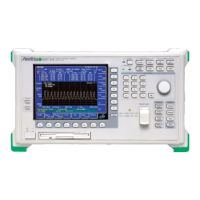
The above rules for <program mnemonic> applies. For example, the MS9710C
uses “SSI” as a mnemonic indicating “sweep.” It is also used as a “simple com-
mand program header” which means execution of sweep without program data.
“CNT” is a mnemonic which means a center wavelength; however, it can be used
as a “simple command program header” to set a center wavelength only when it is
provided with the program data indicating a center waveform.
5.2 Program Message Functional Elements





 To Next Page