Hooks
Always keep the hook clean. Use a cloth to wipe away any dirt.
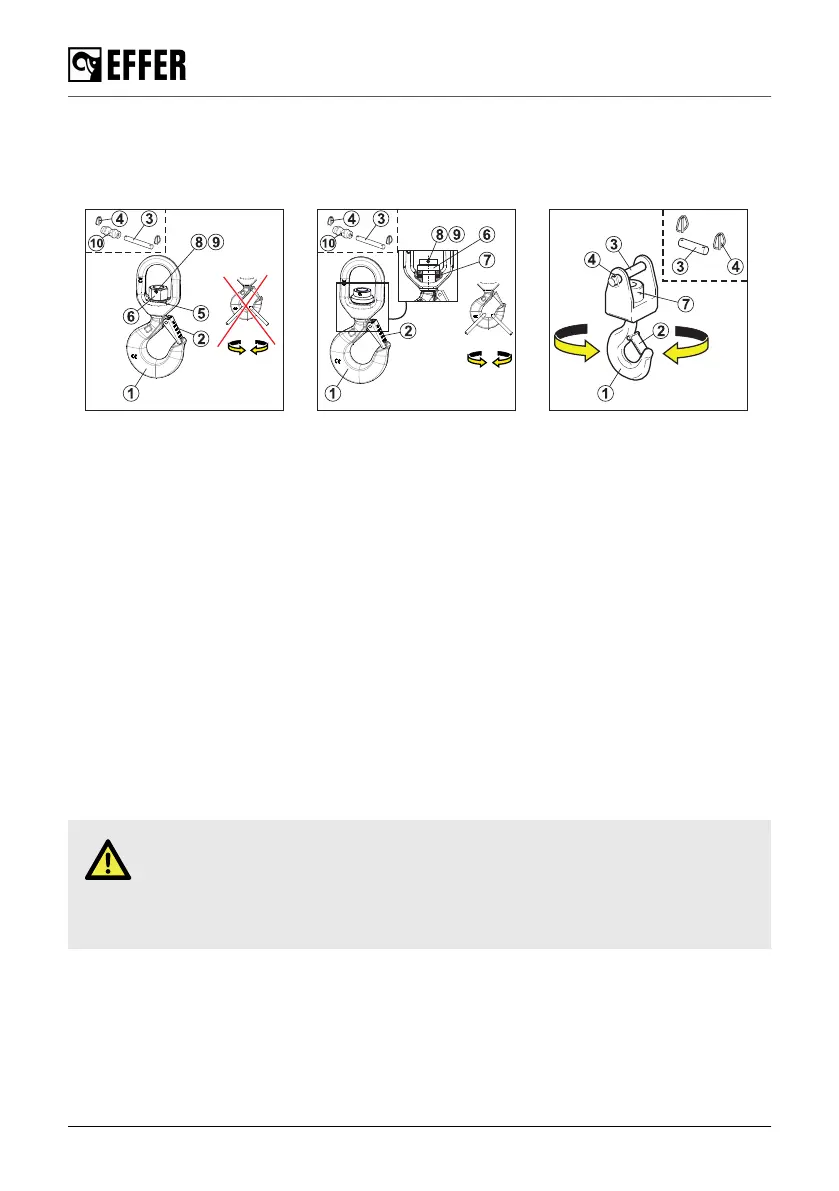
Non swivel hook Swivel hook with bearing Swivel pot hook
Before every working shift:
• Do an inspection of the general conditions of the Hook (1) for deformation (stretched, cracked,
twisted, excessive wear…) and surface damages with significant depth (such as from chemicals
or heat).
• Do an inspection of the clevis/link shaft (3) and/or centring spacer (10) for damage/deformation.
• Do an inspection of the two Spring/Roll pins (8) and (9) that are in place and properly retaining
the central hook nut (6).
The two Spring/Roll pins (8) and (9) should be in place and nearly flush with the outer edge of
the hook nut (6) on both sides.
• Do an inspection of the spring-loaded safety Latch (2). The Latch must close the entire throat
opening.
• Verify that the clevis/link Shaft (3) and/or centring spacer (10) and cotter/safety pin (4) are in
place.
• Verify that the plane bearing/washer (5) or the swivel (7) is in good condition.
• Do a general inspection for deformation and operation of the remaining items: clevis, swivels,
washers, nuts, pins…
• Lubricate the hook according to the chapter "Lubrication of the hooks".
DANGER
In the event of damage or worn to prevent a safety risk:
• Do not use the hook.
• Have the damage repaired immediately by an authorised service workshop.
Add-on equipment and separate accessories (hoist, JIB, etc.)
• Check the cables, cable connections, the cable guides and the attachment points for the add-on
equipment.
• Check the rope, rope connections, the rope guides and the attachment points for the add-on
equipment.
• Maintain all add-on equipment, separate accessories, auxiliary equipment etc. according to the
instructions supplied with it.
Maintenance and Service
146 EFFER 265-315-395-525 Progress 2.0 CE



 To Next Page