In the pop-up window you can:
• Enter the identification label of the keypad in Description. Use only alphabetic characters, including
accented characters, numbers, and spaces.
• Associate the sectors with the keypad (Sectors), by selecting them one by one or selecting them all
by clicking the All button. The None button deletes all associations. To delete a single association,
click on the sector number.
• Associate the scenario with Key A, Key B and Key C.
The following buttons appear under the table:
• Modify: This can be used to configure the wireless keypad highlighted in the table.
• CSV: This can be used to export the keypads table to a “.csv” file, which can be opened with a
spreadsheet.
• PDF: This can be used to export the wireless keypads table to a PDF file.
5.23 Zigbee repeaters
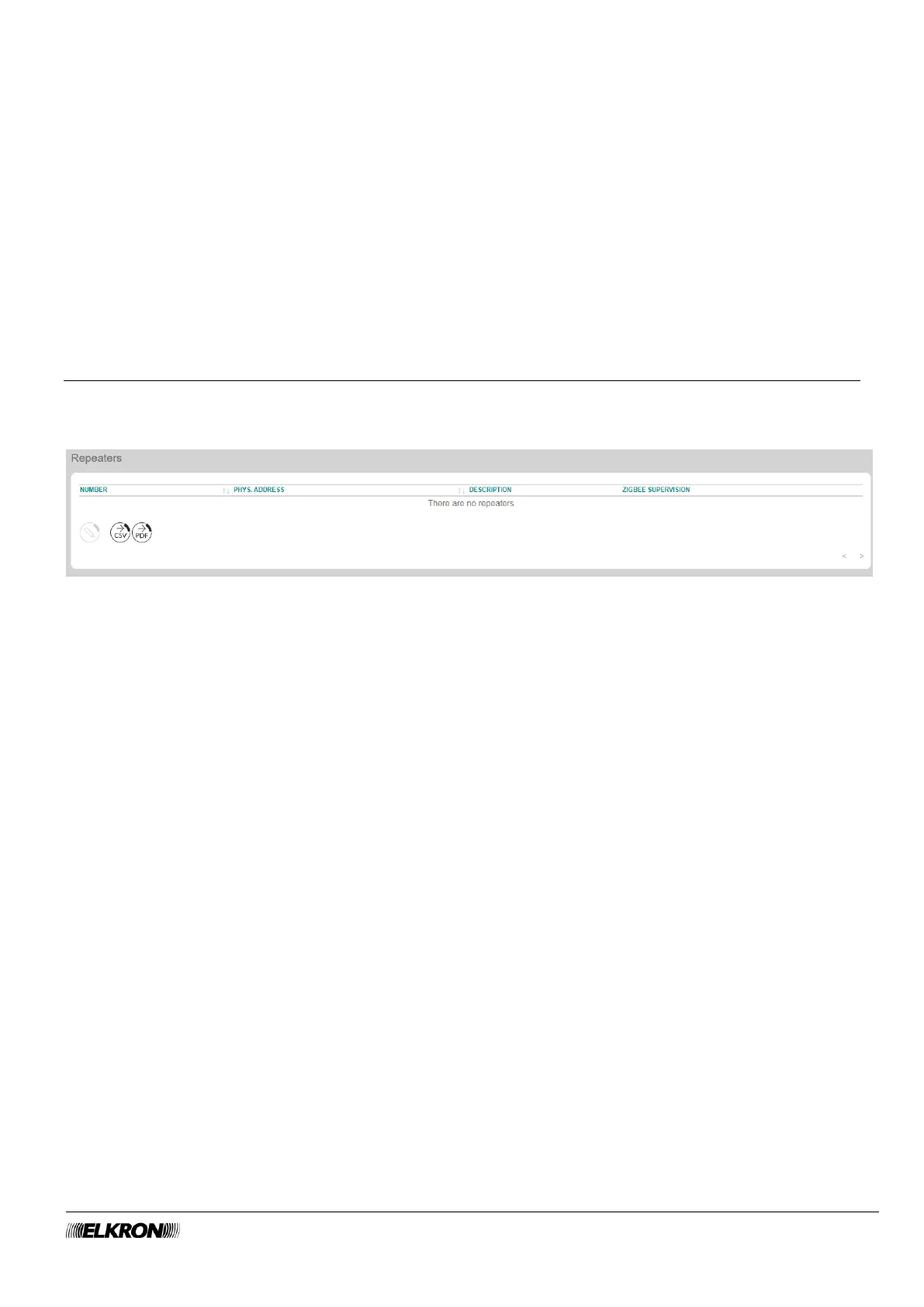
This can be used to view the ZigBee repeaters in the system.
It is accessed through the PROGRAMMATION → Zigbee Peripheral → Zigbee repeaters menu.
Figure 94 - ZigBee repeaters
The table shows:
• NUMBER: This is the sequential number of acquisition of the repeater.
• PHYS.ADDRESS: This is the physical address of the repeater.
• DESCRIPTION: This is the alphanumeric label used to identify the repeater more easily.
• ZIGBEE SUPERVISION: This shows whether supervision is enabled or disabled.
Double-click on the repeater line to open a pop-up window.
• Enter the identification label of the repeater in Description. Use only alphabetic characters, including
accented characters, numbers, and spaces.
• Enable or disable ZigBee supervision of the repeater.
The following buttons appear under the table:
• Modify: This can be used to configure the repeater highlighted in the table.
• CSV: This can be used to export the repeaters table to a “.csv” file, which can be opened with a
spreadsheet.
• PDF: This can be used to export the repeaters table to a PDF file.
The < and > buttons at the bottom right are used to navigate between the pages of the repeaters, if their
number is greater than the number that can be displayed in a single screen.


 To Next Page