284
where emissivity is also dependent on temperature and wavelength are called
non-gray bodies. Furthermore, the sum of emission is composed of absorption
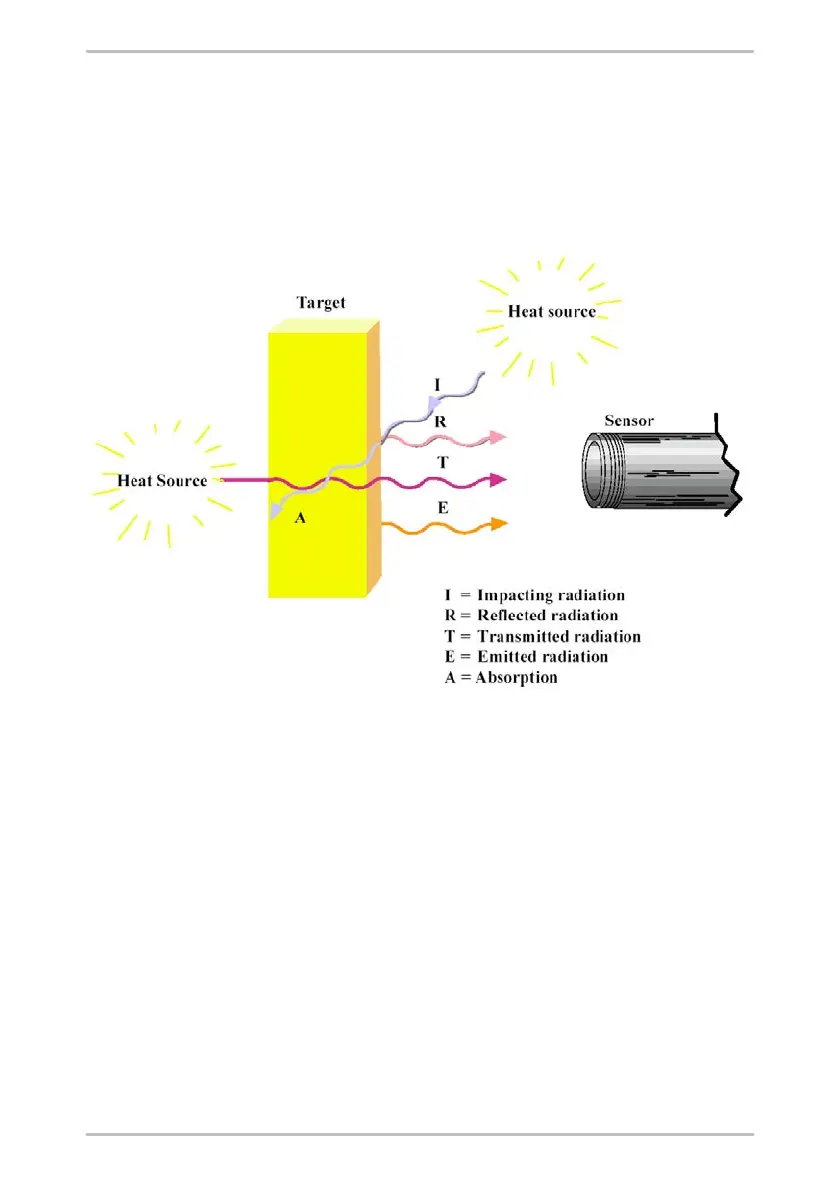
(A), reflection (R) and transmission (T) and is equal to one. (See Equation 1 and
Fig. 4).
A + R + T = 1 (1)
Fig. 4 In addition to the radiation emitted from the target, the sensor also receives reflected
radiation and can also let radiation through.
Solid bodies have no transmission in the infrared range (T = 0). In accordance
with Kirchhof’s Law, it is assumed that all the radiation absorbed by a body, and
which has led to an increase in temperature, is then also emitted by this body.
The result, then, for absorption and emission is:
A <=> E = 1 - R (2)
The ideal blackbody also has no reflectance (R = 0), so that E = 1.
Many non-metallic materials such as wood, plastic, rubber, organic materials,
rock, or concrete have surfaces that reflect very little, and therefore have high
emissivities between 0.8 and 0.95. By contrast, metals - especially those with
polished or shiny surfaces - have emissivities at around 0.1. IR thermometers



 To Next Page