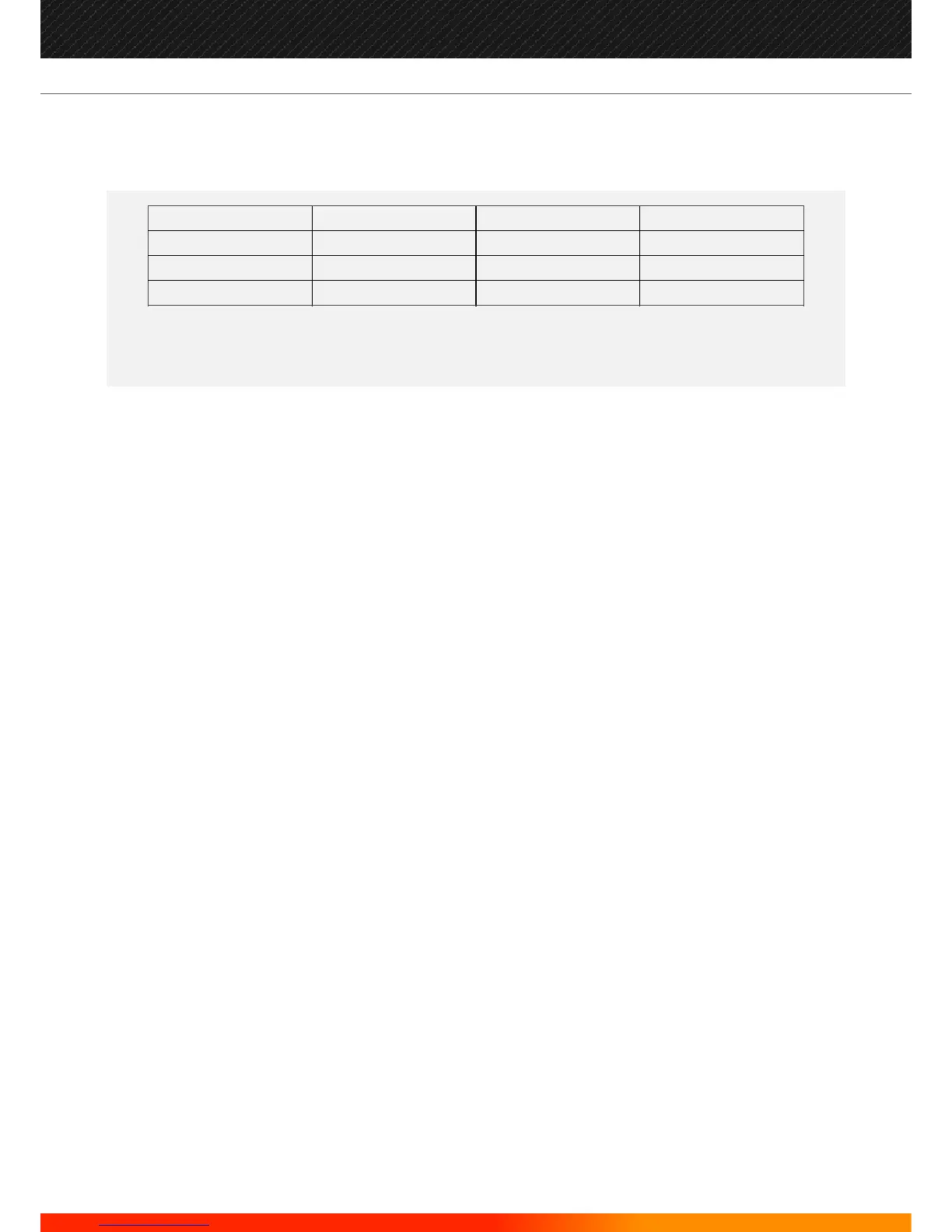
SAM's will respond with the following fixed analogue values, depending on their state:
TROUBLE SHOOTING
a) SAM does not program
If during the course of programming a SAM, the new address is not programmed in the module, verify that the
connections to both the loop and the conventional device are correctly made. Confirm supply polarity of the
conventional device. Always follow manufacturer’s instructions. Check loop voltage at the SAM terminals followed by
a verification of the conventional device voltage, measure voltage across the supply wires (black & red). In normal
operation it should always be greater than 16 V DC.
Verify the condition of the whole system in particular supplies (main, auxiliary and loop), earth leakage, loop length
too long, loop with a short or open circuit, main panel and sub-panel communications. If all of these are OK then do a
system reset after which you should verify, using function 7.1, if there are devices with duplicated address. If there
are, clear those addresses and reprogram SAM’s that previously had identical addresses.
In the eventuality that one SAM does not program but there is no evidence of two devices having identical addresses
after a system reset has been performed, clear the last programmed address using function 6.4.3 and reprogram
SAM. If that does not solve problem replace SAM module. Remember that a duplicate address fault will only show
with ASET mode disabled.
b) SAM with duplicate addresses
In an installation with SAM’s, should there be a fault of 2 devices or more with the same address (duplicate address
fault) two actions can be taken:
1) CLEAR LOOP. Clear the loop where some SAM’s have duplicate addresses. See function 6.4.2. This action should
only be applied when in a brand new installation where all SAM’s should have been blank (no address
programmed).
2) Alternatively the duplicated address can be erased using function 6.4.3
Reset the panel and verify, using function 7.1, the offending address and henceforth the associated FAULT condition
has disappeared. Re-program cleared devices. Repeat procedure until fault disappears. If after the third time the
address clearing procedure has been repeated the fault persists, replace SAM’s with duplicate addresses.
It should be observed that this verification can only be performed when ASET mode is disabled, since the fault
condition where 2 devices have the same address, is not shown when in this particular mode.
UPON COMPLETION OF THE INSTALLATION AND COMMISSIONING STAGES A FIRE
DETECTION SYSTEM SHOULD ALWAYS OPERATE IN ACTIVE MODE
NORMAL
20
20
20
FAULT
8
8
N/A
ACTIVATED-FIRE
80
80
64
Smoke
Heat
Call Point
90
Manufacturers of Fire Detection Equipment
INSTALLATION & COMMISSIONING MANUAL REVISION 4.0 05/2013
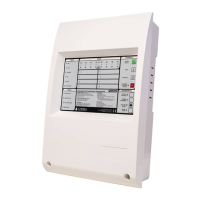
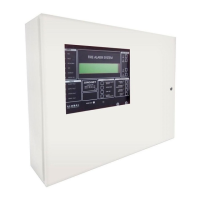
JUNO NET - NETWORKABLE ADRESSABLE PANEL
globalfire.pt


 To Next Page